

What Are the Pros and Cons of Adding POE to EVA?
Why Does Twin-Screw Dispersion Become Critical When SEBS Is Added?
Explore how POE modifies EVA hardness, rebound and low-temperature flexibility, and how SEBS improves melt elasticity, tear resistance and foam cell stability. This technical guide covers EVA/POE/SEBS morphology, twin-screw pre-compounding, SEBS dispersion, DCP crosslinking, foam structure control, shrinkage and formulation optimization.
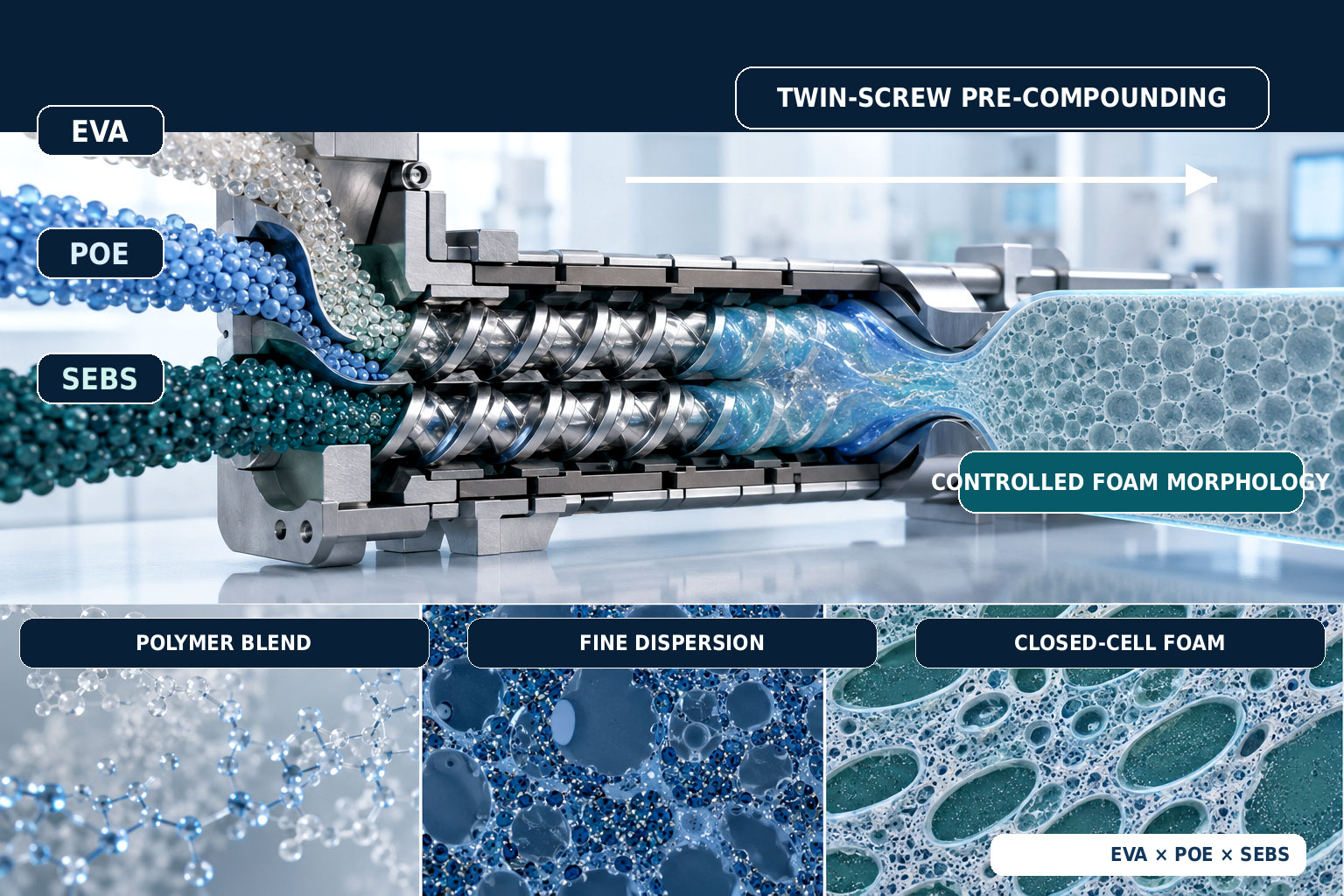
1. Why Is POE Commonly Added to EVA? Start with Molecular Structure
EVA is an ethylene-vinyl acetate copolymer. The ethylene segments provide crystallizable regions and the basic structural framework. VA side groups disrupt the polyethylene crystal lattice; as VA content increases, the material generally becomes softer and more polar with better adhesion, while melting point, crystallinity and heat-resistant structural support tend to decrease. POE is typically a random copolymer of ethylene and an alpha-olefin. Its polyolefin backbone, low glass-transition temperature and soft elastic character provide a degree of compatibility with the ethylene segments of EVA.
Main Benefits of Adding POE to EVA
Lower hardness and flexural modulus: polymer modification can replace part of heavy oil extension, reducing the risk of oil bleed or a tacky surface.
Better low-temperature flexibility and impact resistance: the low Tg of POE helps suppress low-temperature embrittlement, making it suitable for footwear, protective equipment and cushioning foams.
Higher rebound potential: an appropriate POE phase can reduce energy loss and accelerate recovery after compression.
Higher elongation at break and fatigue resistance: finely dispersed domains can blunt crack tips and slow crack propagation.
Tunable melt rheology: a suitable POE grade can improve cell growth during foaming and help tune surface feel.
Partial Compatibility Does Not Mean Complete Miscibility
EVA and POE usually form a partially compatible or multiphase morphology. VA content, POE comonomer content, molecular weight, viscosity ratio and compounding history all affect domain size. If POE forms excessively large droplets or a local continuous phase, properties are no longer simply additive; tear strength may fall, cells may coarsen and shrinkage may increase.
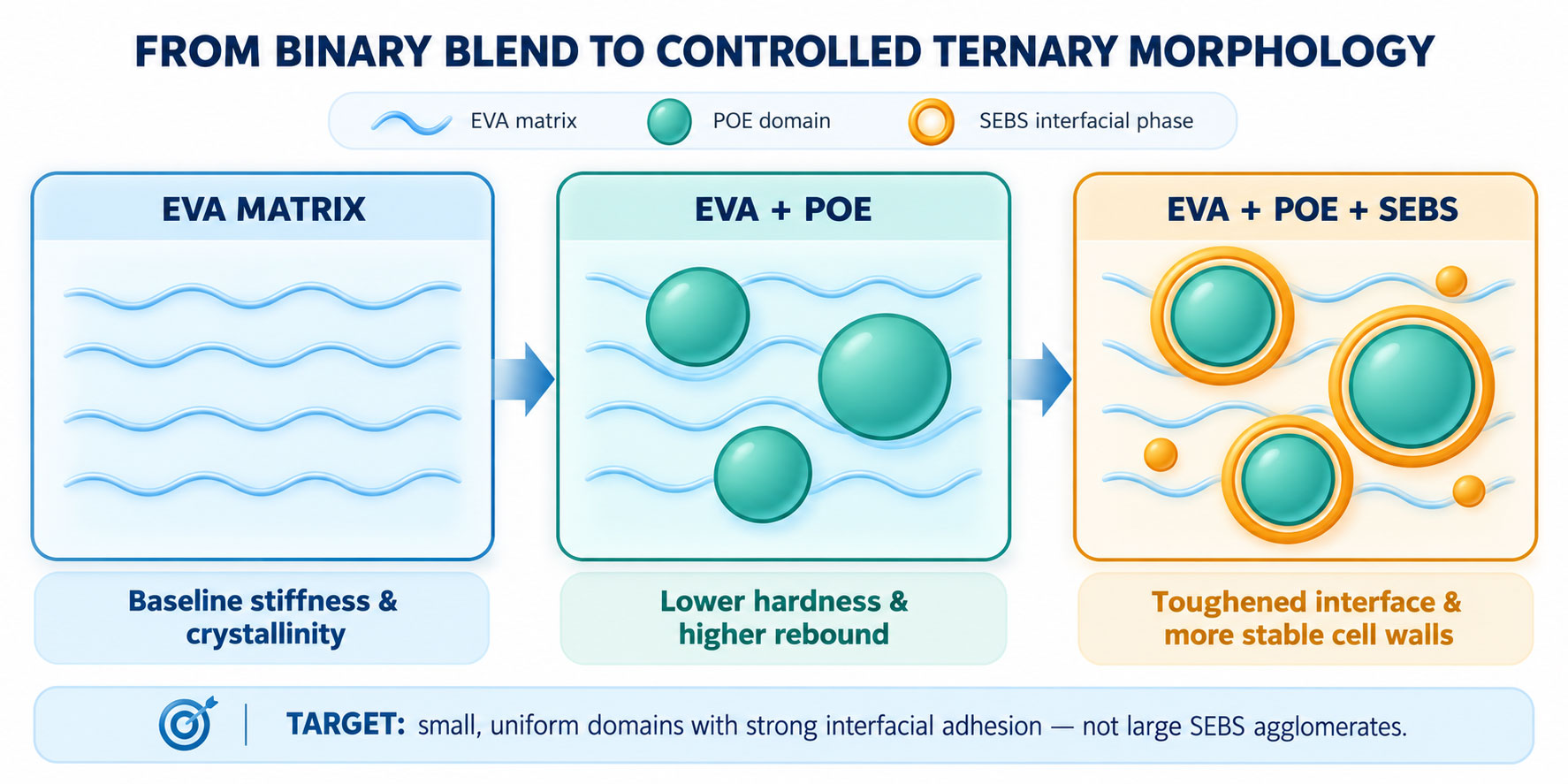
2. Drawbacks of Adding POE to EVA: Crystallinity, Interfaces and Reaction Dilution
| Potential Drawback | Polymer Mechanism | Likely Effect in Foamed Product |
|---|---|---|
| Reduced heat resistance and dimensional stability | POE generally lowers overall crystallinity; low-melting crystalline regions lose support at lamination temperatures | Secondary shrinkage, warpage, edge curl |
| Tear strength may not improve proportionally | Excessively large domains or insufficient interfacial adhesion allow cracks to propagate along phase boundaries | Soft feel but poor tear resistance; earlier dynamic-fatigue failure |
| Altered crosslinking efficiency | POE dilutes EVA, and different chain structures show different efficiencies toward DCP free-radical reactions | Insufficient gel fraction or a need to retune DCP |
| Foaming ratio and cell morphology drift | Viscosity, melt strength and gas-generation/network-formation timing are altered | Unstable density, coarse cells, coalescence or shrink-back |
| Reduced adhesion and printability | Higher low-polarity POE content reduces surface energy and polarity | More difficult fabric lamination, adhesive bonding, coating or printing |
| Compression set may worsen | When the blend is too soft and the network is insufficient, chain slippage increases | Higher compression set and poorer long-term support |
| IMPORTANT | Hardness or rebound cannot be compared directly at different densities. If a POE formulation expands to a higher foaming ratio, it will naturally be softer. R&D evaluation should first fix final-part density before attributing differences to the material itself. |
Key Morphology Parameters: Viscosity Ratio and Interfacial Tension
In a blend under shear, dispersed-domain size is governed by interfacial tension, shear stress and viscosity ratio. Droplet deformation can be interpreted with the capillary number, Ca = ηm·γ̇·R/σ: higher matrix viscosity ηm, shear rate γ̇ or droplet radius R makes the dispersed phase easier to stretch, while higher interfacial tension σ resists breakup. However, if the dispersed phase is too viscous, residence time is insufficient, or droplets rapidly coalesce after breakup, coarse domains can remain.
3. Why Add SEBS? It Reinforces What POE Does Not Do Well
SEBS is a styrene-ethylene/butylene-styrene block copolymer. At room temperature, the polystyrene end blocks form hard microdomains that act like reversible physical crosslinks, while the ethylene/butylene soft midblock has an interaction basis with POE and the ethylene segments of EVA. SEBS can therefore provide melt elasticity, toughness and damping without relying entirely on crystallinity.
Improvements SEBS Can Provide
Higher melt elasticity and cell-wall strength: helps suppress cell coalescence, rupture and mold-opening shrink-back.
Better tear resistance and crack blunting: finely dispersed SEBS domains can absorb crack energy, especially under repeated flexing and dynamic service.
Tune the rebound-damping balance: POE tends to favor elastic recovery, while SEBS can add damping and flexibility depending on grade, styrene content and oil extension.
Reduce reliance on low-melting POE for softening: this can retain more EVA crystalline support and dimensional stability.
Improve low-temperature toughness and hand feel: the EB soft block maintains flexibility at low temperature, while PS microdomains help retain shape at room temperature.
SEBS Also Introduces Trade-Offs
| Risk | Cause | Control Direction |
|---|---|---|
| Dispersion difficulty | High-molecular-weight SEBS has high melt viscosity and slow particle swelling | Pre-dry/preblend; increase residence time and dispersive mixing |
| Hard spots or gel particles | SEBS is not fully plasticized or local concentration is too high | Twin-screw pre-pelletizing, screen-pressure monitoring and microscopic sectioning |
| Rough surface | Large domains, viscosity mismatch or volatiles | Adjust screw configuration, temperature and vacuum venting |
| DCP reaction is redistributed | SEBS, EVA and POE differ in radical-reaction and degradation tendencies | Preblend the polymers first; add DCP in a separate stage and rebuild the cure curve |
| Higher cost and recycling complexity | A ternary formulation, masterbatch and two-stage processing add cost | Evaluate total benefit in yield, tear resistance and service life |
4. Why Does SEBS Benefit More from Twin-Screw Compounding? Dispersion and Distribution Are Different
Distributive mixing moves components throughout the bulk volume; dispersive mixing applies enough stress to break agglomerates and large domains. Even when SEBS pellets appear visually well mixed, unplasticized cores may remain inside. Internal mixers or single-screw extruders can handle some formulations, but when the goal is stable fine-domain morphology, continuous production and batch-to-batch consistency, co-rotating twin-screw pre-compounding is usually the more reliable industrial route.
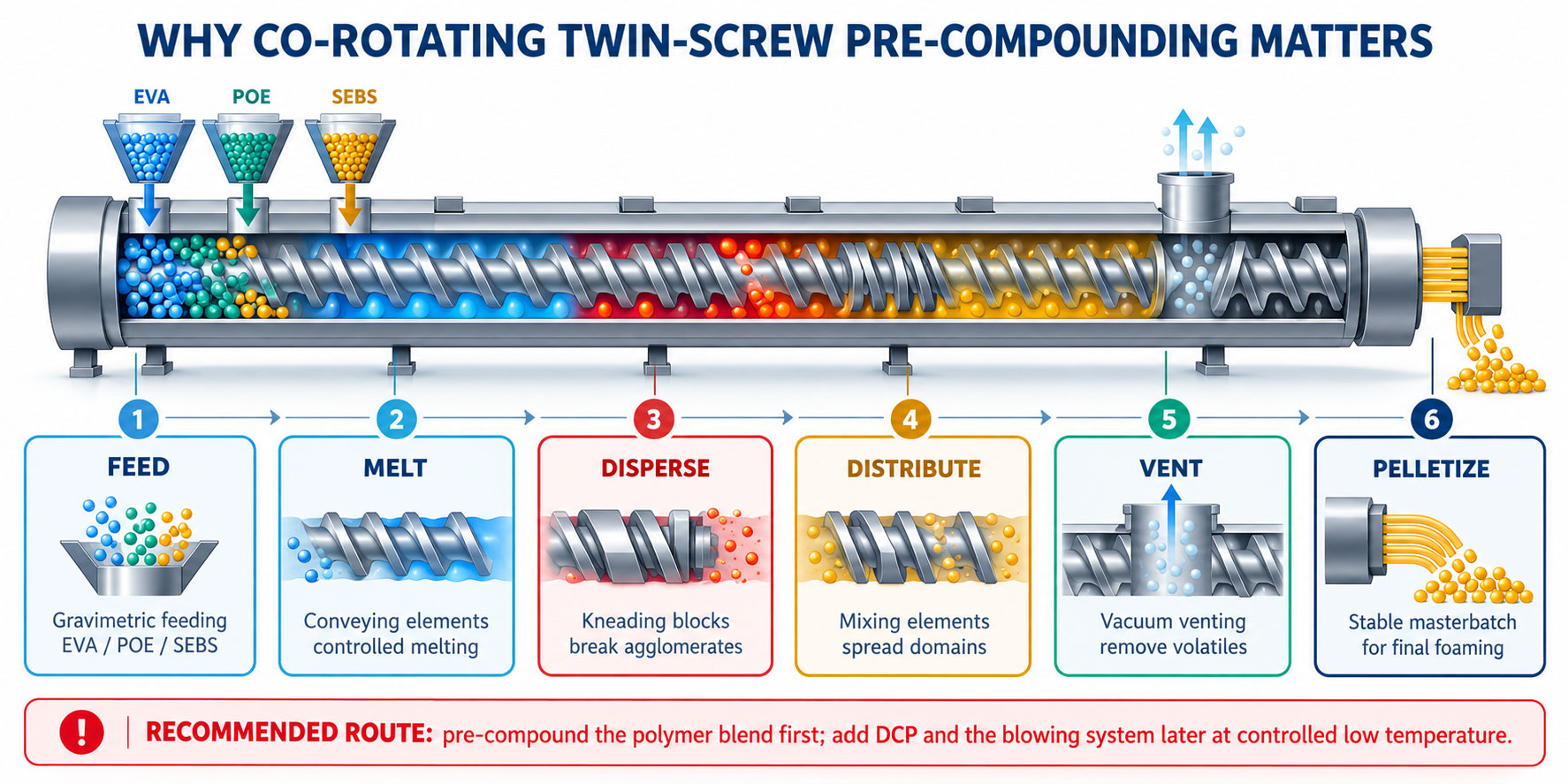
Four Core Advantages of Twin-Screw Compounding
High interfacial renewal rate: intermeshing screws repeatedly split, recombine and stretch the melt.
Zone-specific shear design: conveying elements move the material forward, while kneading blocks provide controlled dispersion without applying high shear throughout the entire barrel.
Precise feeding and side feeding: high-viscosity SEBS, oils, compatibilizers or fillers can be introduced at the appropriate location.
Vacuum venting and stable pelletizing: moisture and volatiles are removed to produce a uniform masterbatch for subsequent low-temperature addition to the foaming system.
5. More Shear Is Not Always Better: Control SME and Melt Temperature
The value of a twin-screw extruder is not simply to run at the highest screw speed; it is to build morphology using repeatable specific mechanical energy (SME), residence time and melt temperature. SME is an engineering indicator of the mechanical energy actually applied per kilogram of material. Too little energy cannot break down SEBS agglomerates, while too much can increase EVA thermal history, cause chain scission or discoloration, and narrow the downstream foaming window.
| Process Variable | When Too Low | When Too High | Recommended Monitoring |
|---|---|---|---|
| Screw speed | Inadequate dispersion, low throughput | Shear heating, degradation, shorter residence time | Screw speed, torque, SME, melt temperature |
| Kneading-block angle/count | Residual SEBS agglomerates | Excessive pressure and temperature rise | Die pressure, pellet cross-sections, screen differential pressure |
| Feed rate | Residence time too long; thermal degradation risk | Excessive fill; insufficient mixing | Torque %, throughput, specific energy |
| Temperature setting | Incomplete plasticization | Excessive thermal history of EVA/additives | Actual melt temperature by zone, not just setpoints |
| Vacuum venting | Residual moisture and volatiles | Over-venting may strip low-molecular additives | Vacuum level, volatiles, bubbles in pellets |
| SAFER TWO-STAGE ROUTE | Stage 1: make only the EVA/POE/SEBS polymer masterbatch, adding a compatibilizer if needed. Stage 2: add DCP, blowing agent and activation system in a low-temperature internal mixer or other suitable equipment. Avoid exposing active peroxide and blowing agents to unnecessary thermal history in a high-shear twin-screw process. |
6. When Is a Compatibilizer Needed? SEBS Does Not Automatically Stay at the Interface
The EB midblock of SEBS is generally more compatible with POE, but as EVA polarity increases with VA content, interfacial tension may still rise. If microscopy shows large domains, tearing follows the interface, or lamination performance drops significantly, compatibilization strategies such as EVA-g-MAH, SEBS-g-MAH or EAA can be evaluated. A compatibilizer can reduce interfacial tension, suppress coalescence or create interfacial reactions; excessive addition, however, may increase viscosity, moisture uptake, alter crosslinking or change foaming behavior.
7. How Does Dispersion Quality Directly Affect Foaming?
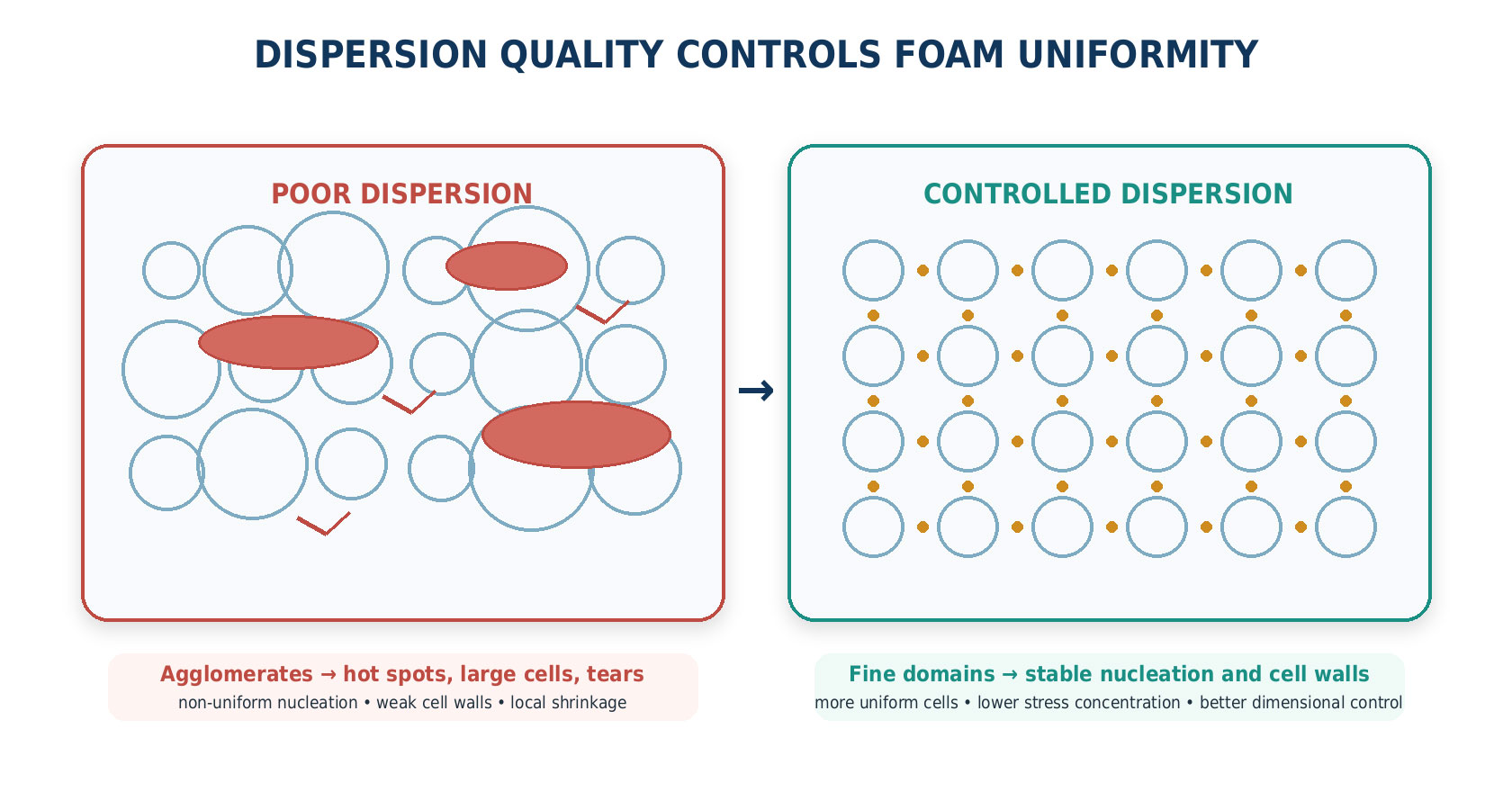
Non-uniform nucleation: coarse particles, contaminants or interfacial voids can cause localized over-nucleation alongside large cells.
Weak cell walls: when a large domain crosses a cell wall, the interface can become the starting point for rupture and tearing.
Non-uniform crosslinking: differences in the contact history between DCP and the polymers can create local fluctuations in gel fraction and melt strength.
Localized hot spots: high-viscosity agglomerates increase shear heating and can cause color variation, scorch or premature blowing-agent reaction.
Surface and dimensional instability: coarse or ruptured cells and interfacial shrink-back can amplify surface roughness and post-shrinkage.
Recommended Methods for Verifying Dispersion
| Level | Method | Information Obtained |
|---|---|---|
| Rapid process monitoring | Torque, SME, melt temperature, screen differential pressure | Batch energy input, thermal history and agglomeration trend |
| Pellets/sheets | Optical microscopy, stained sections, surface scanning | Black specks, unmelted particles and phase-size distribution |
| Advanced morphology | SEM/AFM; selective etching | Dispersed-domain size, interfaces and continuity transitions |
| Thermal analysis | DSC, DMA | Changes in crystallinity, Tg, PS microdomains and damping window |
| Crosslinking rheology | MDR, dynamic rheology, gel fraction, swelling | Crosslinking-gas evolution window and network integrity |
| Foam performance | Density, cell size/distribution, tear, rebound, compression set | Whether morphology truly translates into end-product benefit |
8. Recommended Processing Route: Make a Polymer Masterbatch First, Then Perform Reactive Foaming
Raw-material specification: confirm EVA VA content and MFR, POE density/melting range, and SEBS styrene content, molecular weight and oil extension.
Loss-in-weight feeding: use stable metering for SEBS, compatibilizers and oils to avoid batch variation caused by volumetric feeding.
Twin-screw pre-compounding: plasticize EVA/POE first, then introduce SEBS; use kneading blocks to establish dispersion and mixing elements to complete distribution.
Vacuum venting and filtration: control volatiles, unmelted particles and contaminants before water- or air-cooling and pelletizing.
Second-stage low-temperature mixing: add DCP, blowing agent, activators and other heat-sensitive additives while strictly limiting actual compound temperature.
Conditioning and molding: standardize masterbatch aging, moisture content and batch conditions before compression or injection foaming.
A Practical Screw-Configuration Concept
Use conveying elements in the front section to establish stable solids transport; complete EVA/POE melting in the first mixing zone; use medium-angle kneading blocks in the middle section to fully plasticize SEBS and break agglomerates; then use distributive mixing elements in the rear section to narrow the domain-size distribution before vacuum venting and pressure-stabilized metering. If material temperature becomes too high, first adjust kneading intensity, fill level and cooling rather than simply lowering barrel set temperatures.
9. Recommended DOE: Optimize Formulation, Dispersion and the Foaming Window Together
| Factor | Suggested Levels | Primary Responses |
|---|---|---|
| POE ratio | Low / Medium / High | Hardness, rebound, DSC, shrinkage |
| SEBS ratio | 0 / Low / Medium | Tear, DMA, cell-wall integrity, compression set |
| Compatibilizer | 0 / Low / Medium | Domain size, interfacial failure, adhesion |
| Twin-screw SME | Low / Medium / High | Agglomerate count, melt temperature, MFR change |
| Effective DCP level | Low / Medium / High | t10, t90, gel fraction, expansion ratio |
| Cooling and post-conditioning | Standard / Enhanced | 24/72 h dimensions and secondary heat shrinkage |
Conditions That Must Be Fixed for Fair Comparison
Final-part density and test orientation; otherwise hardness, rebound and tear results are not directly comparable.
Total EVA/POE/SEBS polymer basis and total oil content.
Effective DCP purity, rather than comparing only the commercial product addition weight.
Actual discharge temperature, masterbatch moisture content and conditioning time.
Foaming mold, core temperature, mold-opening time and cooling method.
Recommended Success Criteria
10. On-Site Troubleshooting Table
| Abnormality | Likely Cause | First-Priority Correction |
|---|---|---|
| Hard spots in pellets | SEBS not plasticized, unstable feeding or insufficient residence time | Increase preheating/residence time, adjust the kneading zone and use loss-in-weight feeding |
| MFR increases significantly | Shear/thermo-oxidative degradation | Reduce SME and melt temperature; improve venting and antioxidation |
| Large cell-size variation | Non-uniform phase size; uneven DCP/blowing-agent dispersion | Pre-pelletize the polymer blend; add the active system in the second stage |
| Tear strength decreases | SEBS agglomeration or a weak interface | Inspect morphology, viscosity ratio and compatibilizer |
| Shrinkage after lamination | Insufficient support from low-melting POE, crosslinking or cooling | DSC + MDR + 72 h dimensions; reduce the low-melting-phase fraction |
| Tacky surface or oil bleed | Excessively oil-extended SEBS or oil-phase migration | Verify grade oil content, total oil loading and oil-absorption balance |
Conclusion: The Value of SEBS Is Not “One More Material,” but a Controllable Interface
Adding POE to EVA is an effective strategy for lowering hardness and improving rebound in foamed formulations. However, as the POE ratio increases, crystalline support, polarity, crosslinking efficiency and dimensional stability may all decline. SEBS uses its hard PS microdomains and soft EB midblock to reinforce melt elasticity, tear resistance and cell walls, while reducing the formulation’s dependence on a single low-melting POE phase.
The success of the ternary blend ultimately depends on morphology. If SEBS is not fully plasticized and dispersed, it can become gel particles, weak interfaces and foaming defects. The real purpose of twin-screw pre-compounding is to convert domain size, interfacial renewal, thermal history and batch energy into measurable process parameters. Moving DCP and the blowing agent to a second low-temperature stage then helps balance safety, dispersion and the crosslinking-gas evolution window.