
How to Choose Between EVA and POE? Formulation Principles and Common Issues in DCP Crosslinked Foaming
Material Properties, Formulation Logic, and Common Issues in DCP Crosslinked Foaming
Technical Guide | For Footwear Materials, Insoles, Sports Protective Gear, and Cushioning Foam Products
Abstract
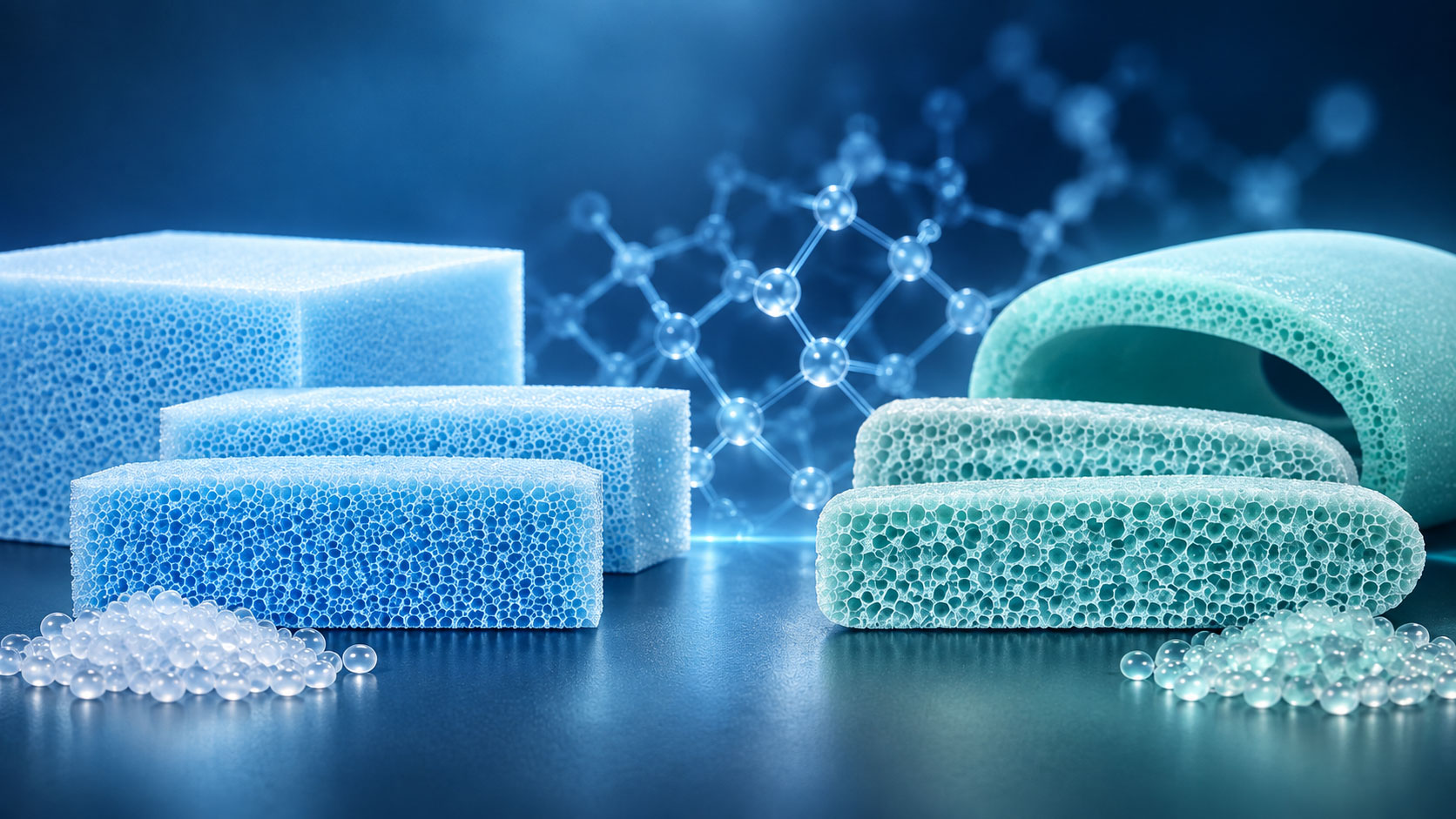
Both EVA and POE can form closed-cell foams through peroxide crosslinking and chemical foaming, but they differ in melting behavior, crosslinking response, melt strength, resilience, and compression set. Material selection should not be based only on hardness or price. Instead, the required end-product performance should be used to work backward to the appropriate resin structure, followed by confirmation that the DCP crosslinking rate is properly matched with the gas-generation rate of the blowing agent.
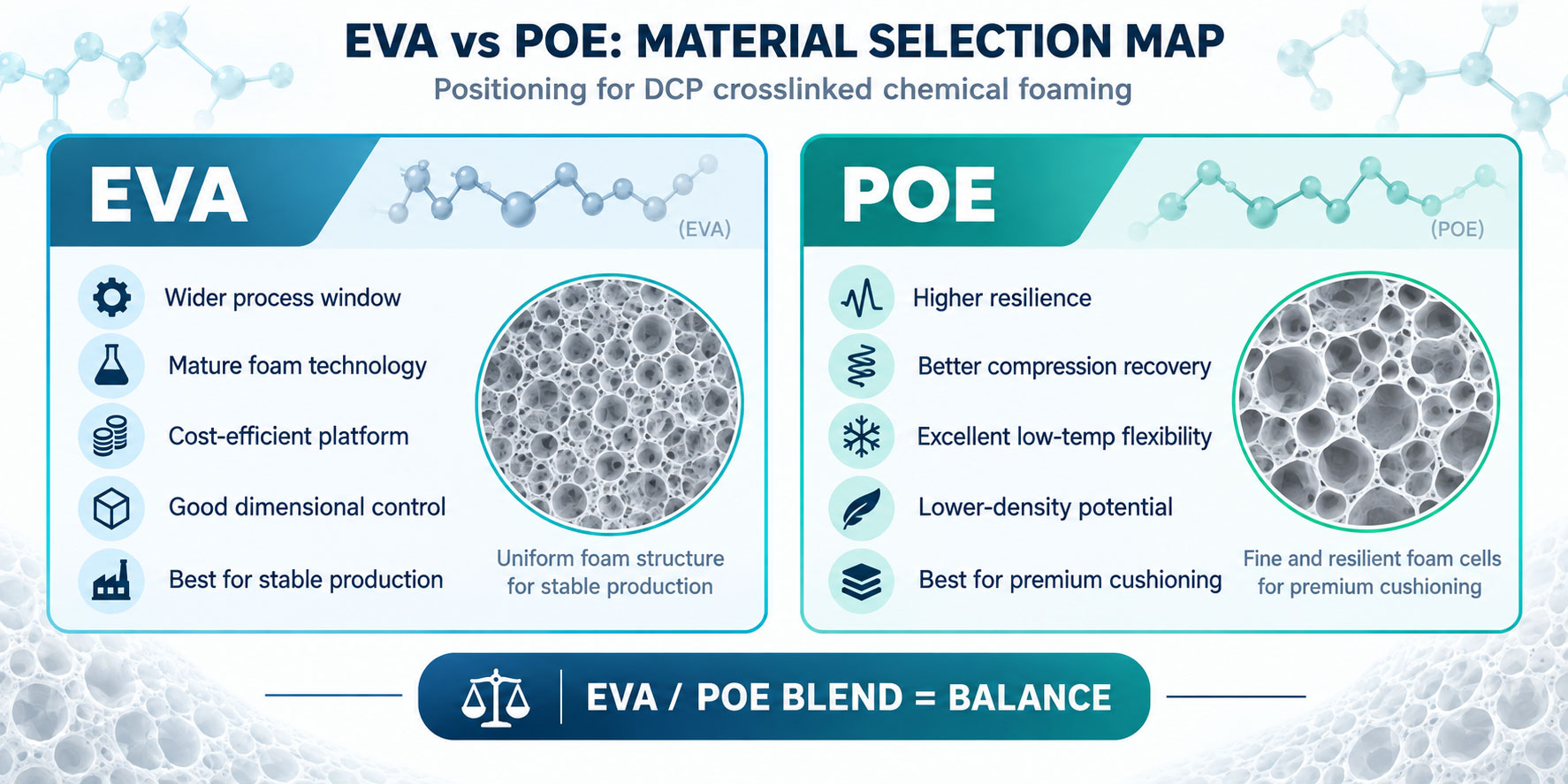
EVA: Mature processing technology, a relatively wide foaming window, good mass-production stability, and better cost control.
POE: Typically offers better resilience, flexibility, low-temperature performance, and recovery after compression, but is more dependent on grade selection and the crosslinking window.
EVA/POE blends: A practical route for many products to balance processability and performance, but the materials should not be replaced on a one-to-one basis without formulation adjustment.
1. The True Role of DCP in Chemical Foaming
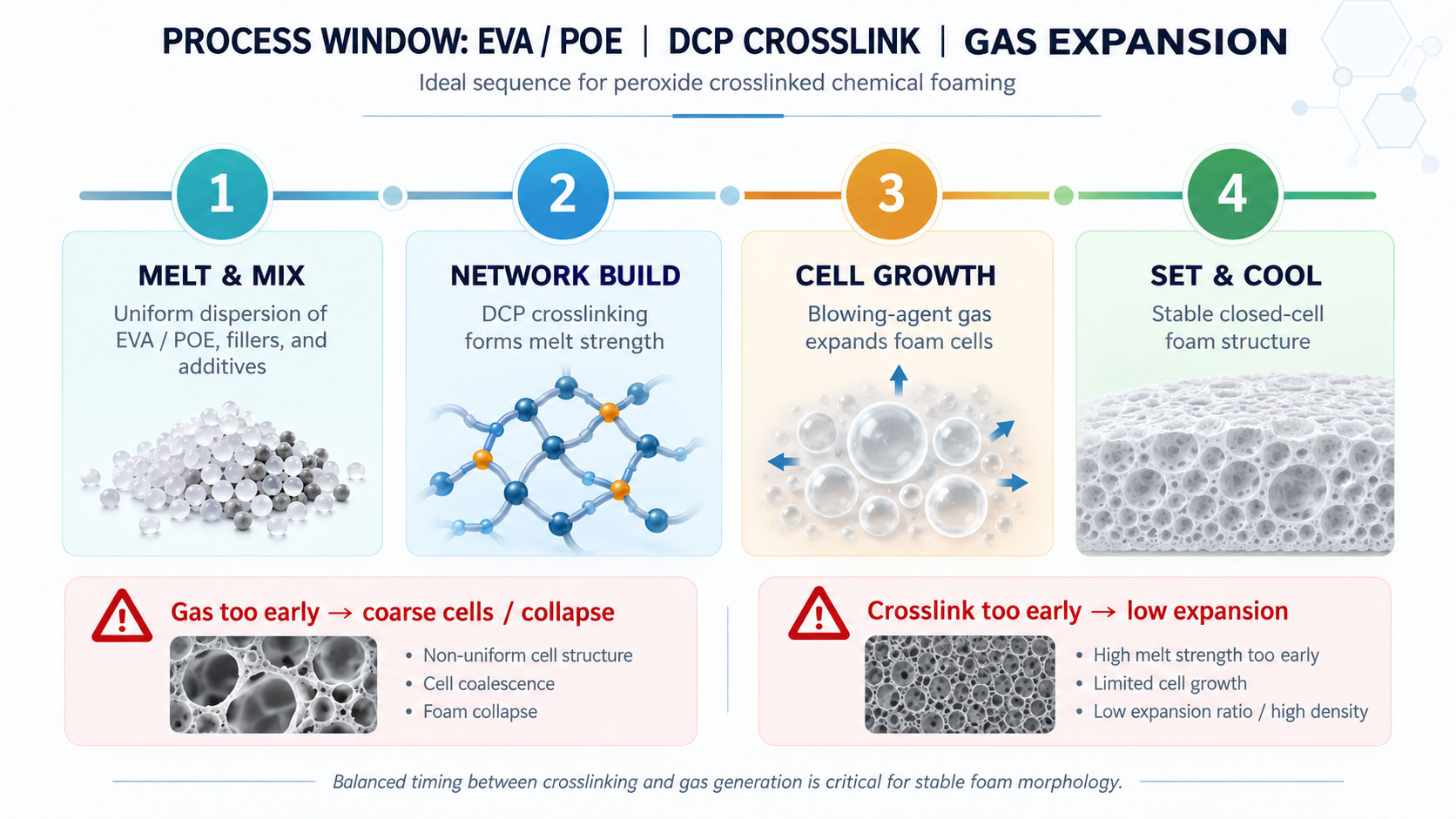
DCP (Dicumyl Peroxide) thermally decomposes to generate free radicals, causing polymer molecular chains to form a crosslinked network. This network increases melt strength, enabling the material to contain and stabilize gas bubbles when the blowing agent releases gas. Conventional chemical foaming systems still require ADC or other endothermic or exothermic blowing agents as the primary gas source.
| Reaction Condition | Typical Result |
|---|---|
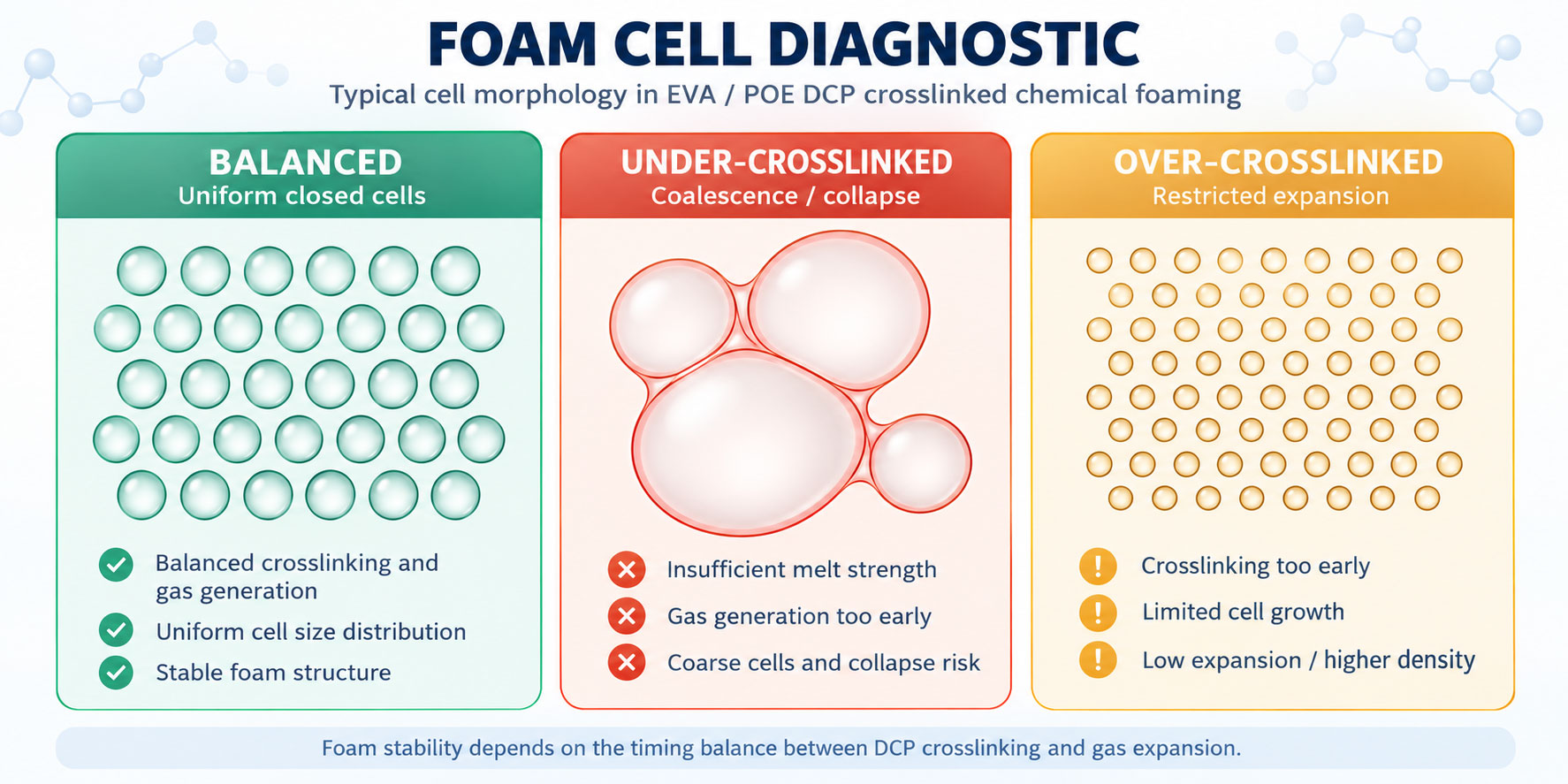
| Foaming too fast, crosslinking too slow | Large cells, cell coalescence, foam collapse, skin rupture, and post-shrinkage |
| Crosslinking too fast, foaming too slow | Restricted expansion, higher density, increased hardness, and rough surface |
| Compound temperature too high during mixing | Premature crosslinking or foaming, causing scorch, reduced flow, and batch instability |
| Insufficient molding / cooling | Incomplete core reaction, dimensional instability, and shrinkback after demolding |
2. EVA: A Mature and Forgiving Foaming Platform
EVA is a copolymer of ethylene and vinyl acetate. As VA content increases, the material generally becomes softer, low-temperature flexibility improves, and crystallinity and melting point decrease; however, stiffness and high-temperature dimensional stability may also decrease. EVA benefits from mature experience in compounding, compression molding, and chemical foaming, making it comparatively easier to establish a stable closed-cell structure.
Suitable Applications for EVA
Shoe midsoles, insoles, and general-purpose cushioning materials
Formulations that prioritize mass-production stability and cost control
Products for which existing equipment and molds already have established EVA molding conditions
Limitations of EVA
At high expansion ratios or low crosslink density, long-term compression set may increase
Excessive filler loading can reduce resilience, elongation, and tear performance
Excessively lowering the crosslink density to achieve low hardness may cause shrinkage or foam collapse
3. POE: Better Performance Does Not Mean Easier Processing
POE is a polyolefin elastomer based on ethylene and α-olefin copolymerization. It generally offers low density, good flexibility, resilience, low-temperature performance, and fatigue resistance. Its value often lies in improving the resilience and post-compression recovery of EVA foam. However, POE grades can differ significantly in molecular weight, melt index, branching structure, and crystallization behavior.
Some low-viscosity or more linear POE grades may not provide sufficient melt strength before an adequate crosslinked network has formed. If the blowing agent releases a large amount of gas too early, coarse cells, foam collapse, skin rupture, or dimensional shrinkage can occur. Therefore, POE grades should not be selected based only on hardness or density.
4. Key Differences Between EVA and POE
| Comparison Item | EVA | POE |
|---|---|---|
| Processing maturity | High; extensive industry experience | Process window must be re-established for each grade |
| Foaming stability | Generally easier to control | More sensitive to melt strength and degree of crosslinking |
| Softness & resilience | Moderate to good | Usually better than conventional EVA |
| Recovery after compression | Weaker at high expansion ratios or low crosslink density | Generally better with appropriate crosslinking |
| Low-temperature flexibility | Good | Usually better |
| Formulation cost | Generally more cost-effective | Typically higher than conventional EVA |
| Primary positioning | General-purpose, stable mass production | High resilience and premium cushioning |
The above are general trends and do not apply to every grade. Actual results are also affected by melt index, comonomer content, filler ratio, oils, antioxidants, and the shear history of the processing equipment.
5. How to Choose EVA, POE, or a Blend
Prioritize EVA When
Cost and mass-production stability are the primary priorities
A wider molding process window is required
The target product hardness is in the medium range
There are no extreme requirements for compression set
Increase the POE Ratio When
High resilience, low-temperature flexibility, or better compression recovery is required
The product must withstand repeated compression and flex-fatigue cycles
The goal is to reduce excessive stiffness in EVA foam or loss of resilience after fatigue
Use an EVA/POE Blend
A blend can use EVA to maintain flow, cell control, and cost efficiency, while POE improves flexibility, resilience, and fatigue resistance. However, as the POE ratio increases, the original balance between DCP and the blowing agent may change. A stepwise substitution approach should therefore be used to gradually establish a new process window.
6. DCP Dosage: Both Too Little and Too Much Can Cause Failure
| Condition | Melt / Cell Behavior | Common Finished-Product Result |
|---|---|---|
| DCP too low | Insufficient network; bubbles readily coalesce or rupture | Foam collapse, wrinkling, shrinkage, and increased compression set |
| Proper crosslinking | Melt can retain generated gas while allowing cell growth | Uniform cells, stable expansion ratio, and stable dimensions |
| DCP too high | Network forms too early, restricting flow and expansion | Higher density and hardness, rough surface, and incomplete filling |
In industry, an initial DCP trial range of approximately 0.5–1.5 phr is common, but it should not be treated directly as a mass-production standard. Differences in purity, carrier form, effective activity, and resin reactivity can all change the outcome. Formal development should use rheological or cure curves to confirm crosslinking onset time, crosslinking rate, maximum torque, and process safety time.
7. Why Does the Original Formulation Often Fail When the POE Ratio Is Increased?
| Change | Technical Reason | R&D Risk |
|---|---|---|
| Melting behavior | Differences in melting point, crystallinity, and melt viscosity | Poor dispersion or premature reaction during mixing |
| Crosslinking efficiency | Molecular-chain structures respond differently to free radicals | The same DCP dosage does not produce the same crosslink density |
| Melt strength | Some POE grades have lower melt strength before crosslinking | Early gas generation can produce coarse cells or foam collapse |
| Dimensional recovery | Elastic recovery and cooling/set behavior change | Shrinkback after demolding and undersized final dimensions |
| Additive effects | Combined effects of oil, fillers, pigments, and antioxidants | The original EVA additive system may not be directly transferable |
8. Recommended Formulation Development Workflow
1 Establish the resin ratio first | Keep the blowing agent and filler constant, and use low, medium, and high POE ratios to observe mixing behavior, expansion, cell structure, and shrinkage.
2 Adjust the crosslinking level next | At the same resin ratio, test low, medium, and high DCP levels and compare density, hardness, and dimensional stability.
3 Match the gas-generation system | After confirming the crosslinking window, adjust blowing-agent dosage, decomposition temperature range, or activation system.
4 Optimize fillers and additives | Confirm the balance among nucleation, cost, resilience, and tear performance.
5 Scale up for mass production | Verify actual compound temperature, resting time, mold-temperature variation, thickness variation, demolding conditions, and cooling conditions.
9. Foam Cell Defect Diagnosis
| Abnormality | Possible Cause | Priority Checks |
|---|---|---|
| Cells too large | Insufficient crosslinking, gas generation too fast, or insufficient melt strength | DCP, blowing-agent activation rate, and POE grade |
| Insufficient expansion | Excessive crosslinking, insufficient gas generation, or insufficient mold temperature | DCP, blowing agent, and heating time |
| Foam collapse after demolding | Insufficient crosslinking, inadequate core temperature, or insufficient cooling | Crosslinking curve, temperature through the thickness, and cooling |
| Rough surface | Over-crosslinking, poor dispersion, or uneven gas generation | Compound temperature, DCP dispersion, and blowing-agent particle size |
| Excessive shrinkage | Insufficient crosslinking, high POE ratio, or insufficient setting | Crosslink density, resin ratio, and cooling fixture |
| Insufficient resilience | High EVA/filler content or poor cell structure | POE ratio, filler loading, and cell uniformity |
10. Final Specifications Should Not Be Based on Hardness Alone
EVA foam and EVA/POE foam with the same hardness can behave very differently in dynamic feel, impact absorption, and long-term compression recovery. At minimum, the following should be evaluated together:
Apparent density and expansion ratio
Cell size, cell distribution, and closed-cell integrity
Hardness, rebound resilience, and compression set
Tensile strength, elongation, and tear strength
Heat shrinkage, post-demolding dimensional change, and low-temperature flexibility
Repeated compression, flexing, and fatigue under actual use conditions
Insoles and Footwear Materials
Greater emphasis should be placed on thickness retention after prolonged compression, underfoot comfort, the balance of resilience and support, as well as resistance to perspiration, hydrolysis, and repeated step fatigue.
Sports Protective Gear
Greater emphasis should be placed on impact-energy absorption, tear strength, conformity/fit, flex recovery, and performance stability across different temperatures.
Conclusion
EVA provides a mature, forgiving, and cost-efficient foaming platform, while POE can improve resilience, flexibility, low-temperature performance, and recovery after compression. The two are not simple substitutes for one another; rather, they are material tools suited to different product positions and processing conditions. For many applications, EVA/POE blending is a practical route to balance performance with manufacturability.
Technical Notice | The additive ranges and adjustment directions presented in this guide are for material-development reference only. Actual formulations must still be validated experimentally and in mass production according to the raw materials, equipment, and finished-product specifications.