

Chemical vs. Supercritical Foaming
Beyond Cell Size: Principles, Equipment, Costs & Recyclability
Applicable to EVA, POE, TPU, TPE, PP, PE, and engineered foam development
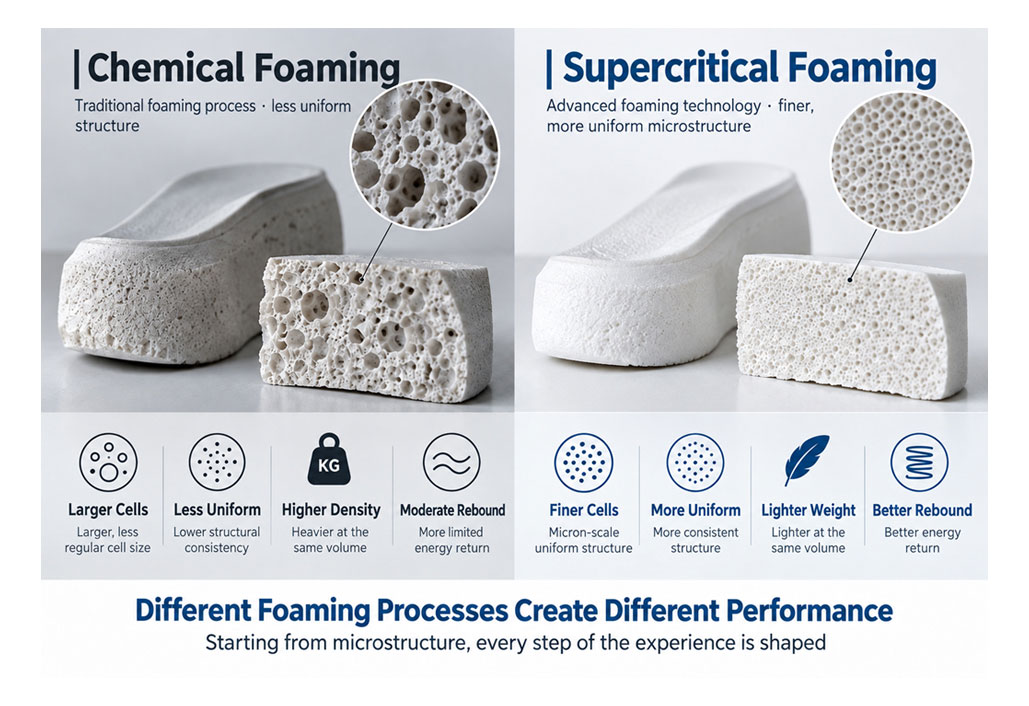
1. Why Is This Comparison Important?
As brands seek lighter products, higher rebound, lower odor, fewer additives, and improved opportunities for recycling, R&D and purchasing teams must reconsider whether conventional chemical foaming remains the best option. Supercritical foaming is often promoted as “greener, finer-celled, and higher-performing,” but its scale-up risks may be underestimated if high-pressure equipment, gas solubility, and process control are overlooked.
In this article, chemical foaming means generating gas through heat-induced decomposition or reaction of a blowing agent. Supercritical foaming uses CO₂ or N₂ at specified temperatures and pressures as a physical blowing medium. The essential difference is not whether bubbles exist, but how gas enters the polymer, when cells nucleate, and how the cellular structure is fixed.
2. Chemical Foaming: Generating Gas by Reaction Within the Material
A chemical blowing agent (CBA) is blended into the resin and decomposes or reacts within a specified temperature range to release gas. Typical exothermic systems include ADC, while endothermic systems can generate gas from bicarbonate/organic-acid combinations. The agent’s decomposition temperature must match the resin-processing temperature, crosslinking rate, and melt strength.
Key Control Factors in Chemical Foaming
The blowing agent must be uniformly dispersed; otherwise, locally enlarged cells or surface defects can form.
If gas evolves too early, the melt lacks strength, causing cell coalescence, rupture, or collapse.
If gas evolves too late, excessive crosslinking or cooling restricts the achievable expansion ratio.
Blowing agents such as ADC leave decomposition by-products that may affect odor, color, haze, or long-term performance.
3. Supercritical Foaming: Dissolve the Gas, Then Trigger Nucleation by Pressure Drop
The critical point of CO₂ is approximately 31.1°C and 7.38 MPa. Beyond this point, there is no distinct liquid–gas boundary, and the fluid can show gas-like diffusion and liquid-like density. Polymer foaming does not necessarily remain strictly supercritical throughout every stage; nevertheless, the industry commonly uses “supercritical foaming” for high-pressure CO₂/N₂ physical foaming.
The process first dissolves CO₂ or N₂ into a polymer under high pressure. The gas can plasticize the polymer by lowering its viscosity or glass-transition temperature. Rapid depressurization or a temperature change then creates supersaturation and numerous cell nuclei. Cell growth followed by cooling and solidification produces microcellular foam.
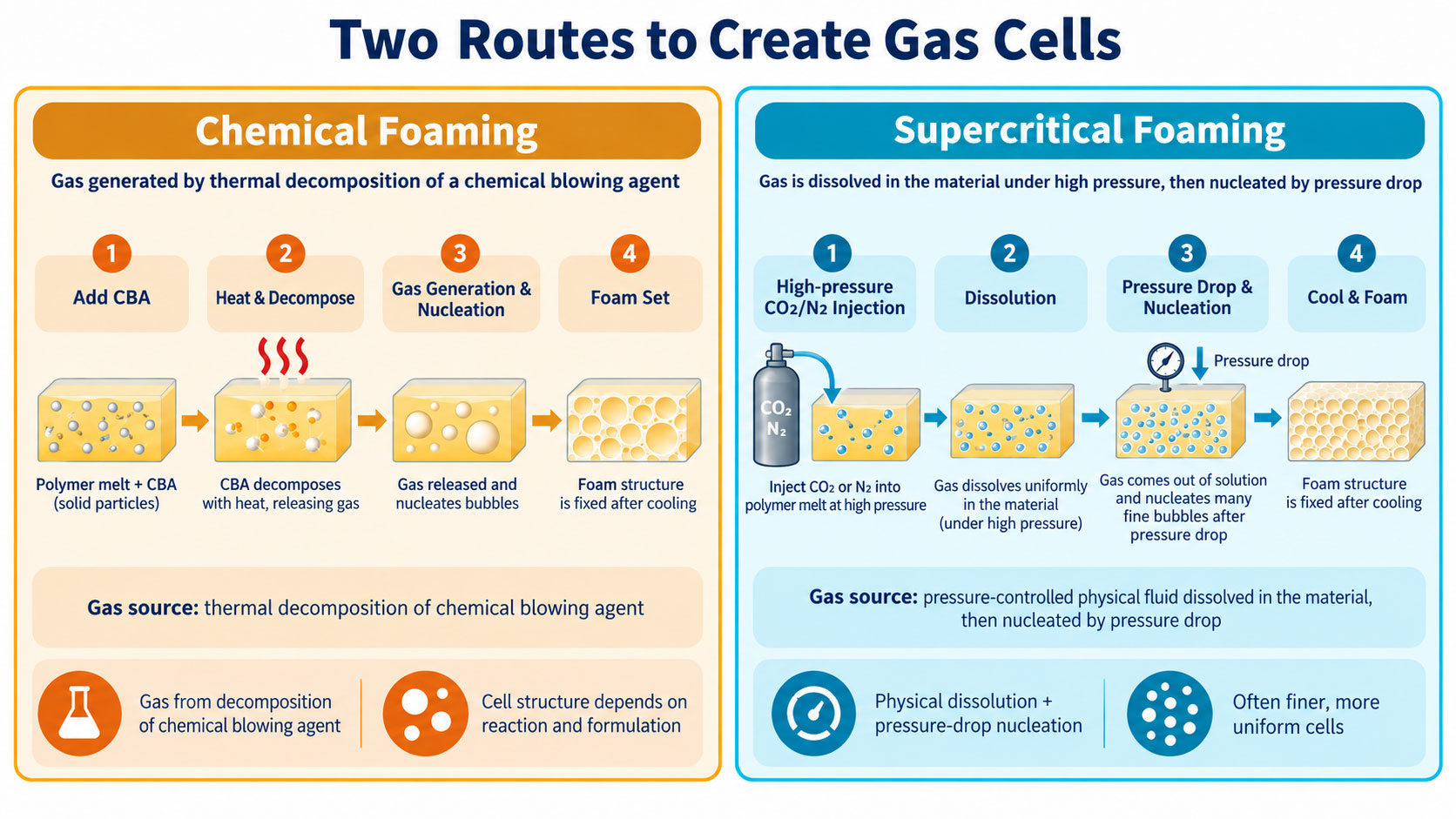
4. Fundamental Differences Between the Two Technologies
| Comparison Item | Chemical Foaming | Supercritical CO₂/N₂ Foaming |
|---|---|---|
| Gas source | Agent decomposes or reacts to release gas | Externally fed gas dissolves under pressure |
| Nucleation trigger | Temperature, activators, reaction kinetics | Pressure drop, heating, solubility change |
| Formulation dependence | High; agent, activator and crosslinking interact | Lower; resin rheology and gas solubility matter |
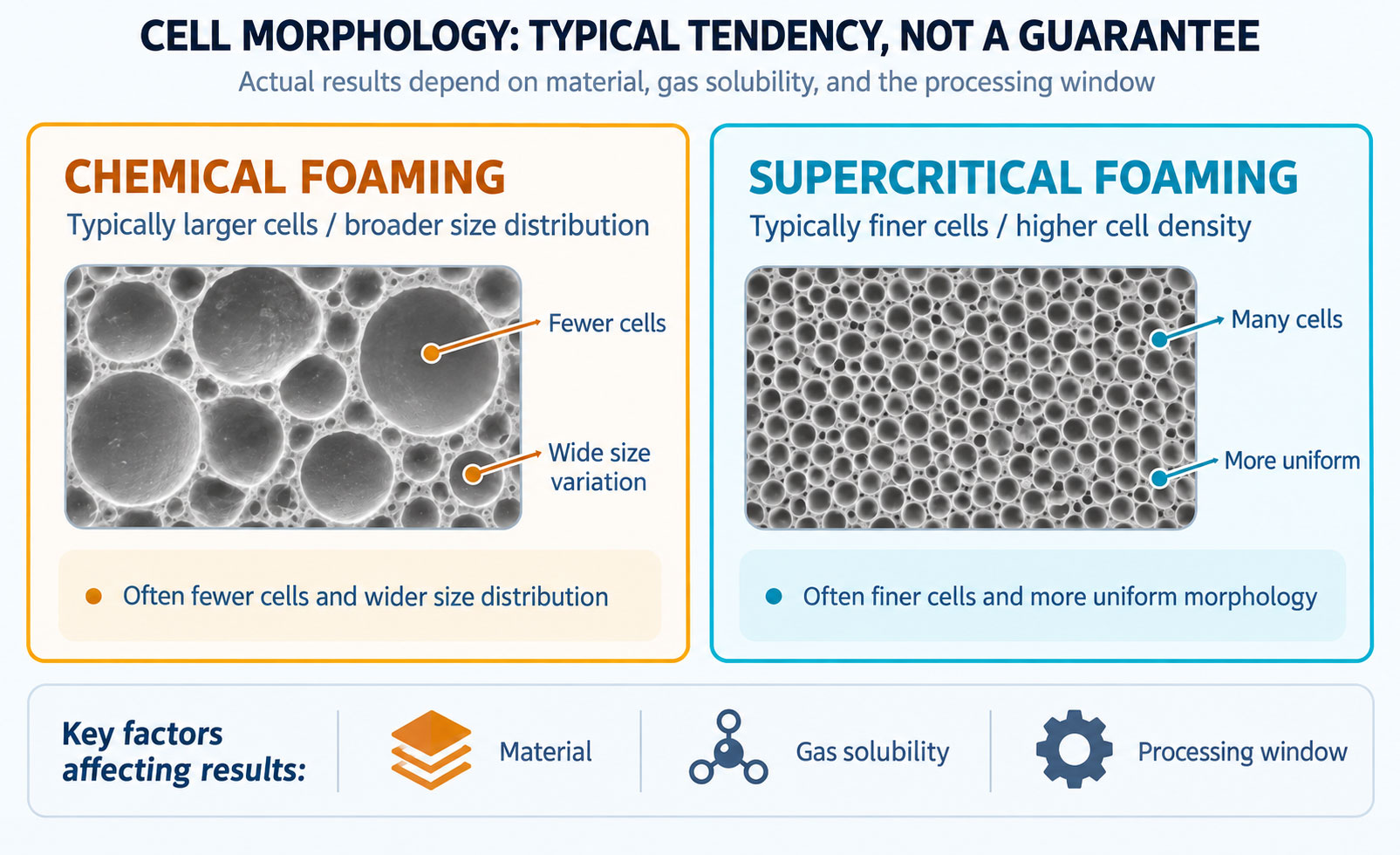
| Typical cells | Uniform closed cells possible; distribution varies with mixing and reaction | Potential for finer cells and higher cell density |
| Residual substances | Decomposition residues may affect odor/color | CO₂/N₂ escapes; usually no solid residue |
| Equipment | Conventional mixers, extrusion, injection, or compression molding | High-pressure dosing, sealing, mixing, safety |
| Process window | Mature; sensitive to formulation and heat history | Sensitive to pressure, heat, gas level, and depressurization |
| Capital requirement | Lower | Higher; increased maintenance and control |
5. Are Cells Always Finer with Supercritical Foaming?
Supercritical foaming often has this potential, but finer cells are not guaranteed. Cell size and density depend on gas solubility, nucleation rate, depressurization rate, melt strength, crystallization behavior, nucleating agents, and cooling rate. Supercritical CO₂ can generate many nuclei under suitable conditions; however, if melt strength is inadequate, the cells may merge, rupture, or shrink after demolding.
6. Performance Comparison: Which Data Should Be Measured?
Density or micrographs alone mislead; match density/hardness to compare cells, mechanics and durability.
| Assessment Area | Recommended Measurements | Interpretation Focus |
|---|---|---|
| Cell structure | Mean cell diameter, distribution, cell density, open/closed-cell content | Do not rely on one attractive cross-section |
| Static properties | Density, hardness, tensile/tear strength, elongation | Control specimen orientation and skin effects |
| Dynamic properties | Rebound, DMA, impact absorption, energy return | High rebound does not mean high shock absorption |
| Durability | Compression set, cyclic compression, heat shrinkage | Track changes in thickness and hardness |
| Appearance | Skin, silver streaks, flow marks, sink marks, and dimensions | Supercritical processing may also cause surface defects |
| Odor and safety | VOC, odor, residues, and material compliance | Evaluate decomposition by-products in chemical foaming |
7. Sustainability and Recyclability: Look Beyond the Use of CO₂
Unlike chemical blowing agents, supercritical CO₂ or N₂ leaves no solid decomposition residue, offering advantages for low odor, cleaner formulations, and certain recycling scenarios. However, using CO₂ alone does not prove that a product has a lower carbon footprint. High-pressure compression, heating, cooling, yield, equipment utilization, and material savings must all be included in a life-cycle assessment.
Likewise, chemical foaming does not automatically make a material unrecyclable. Mechanical recycling may remain feasible when the base resin is thermoplastic, crosslinking is limited, and contamination is controlled. Conversely, extensive DCP crosslinking can form a three-dimensional network and reduce melt reprocessability even with physical blowing gases. Resin structure and crosslinking state—not just the foaming gas—often govern recyclability.
8. Suitability for Different Materials
| Material | Chemical Foaming Considerations | Supercritical Foaming Considerations |
|---|---|---|
| EVA/POE | Mature formulations; balance DCP crosslinking against gas generation | Soft materials tend to shrink; control crosslinking/crystallization and cooling |
| TPU | Control thermal history, moisture, and gaseous by-products | Good CO₂ solubility, but manage shrinkage, skin, and dimensional stability |
| PP/PE | Adequate melt strength is essential; branching, crosslinking, or blending can help | Long-chain branching, high melt strength, and crystallization window are key |
| PLA | Thermal degradation and crystallization rate affect cell stabilization | scCO₂ is well studied; drying, crystallization, and processing window remain critical |
| TPE/TPV | Phase structure affects cell uniformity | Verify differences in gas solubility and diffusion among phases |
9. Which Technology Is Better Suited to Mass Production?
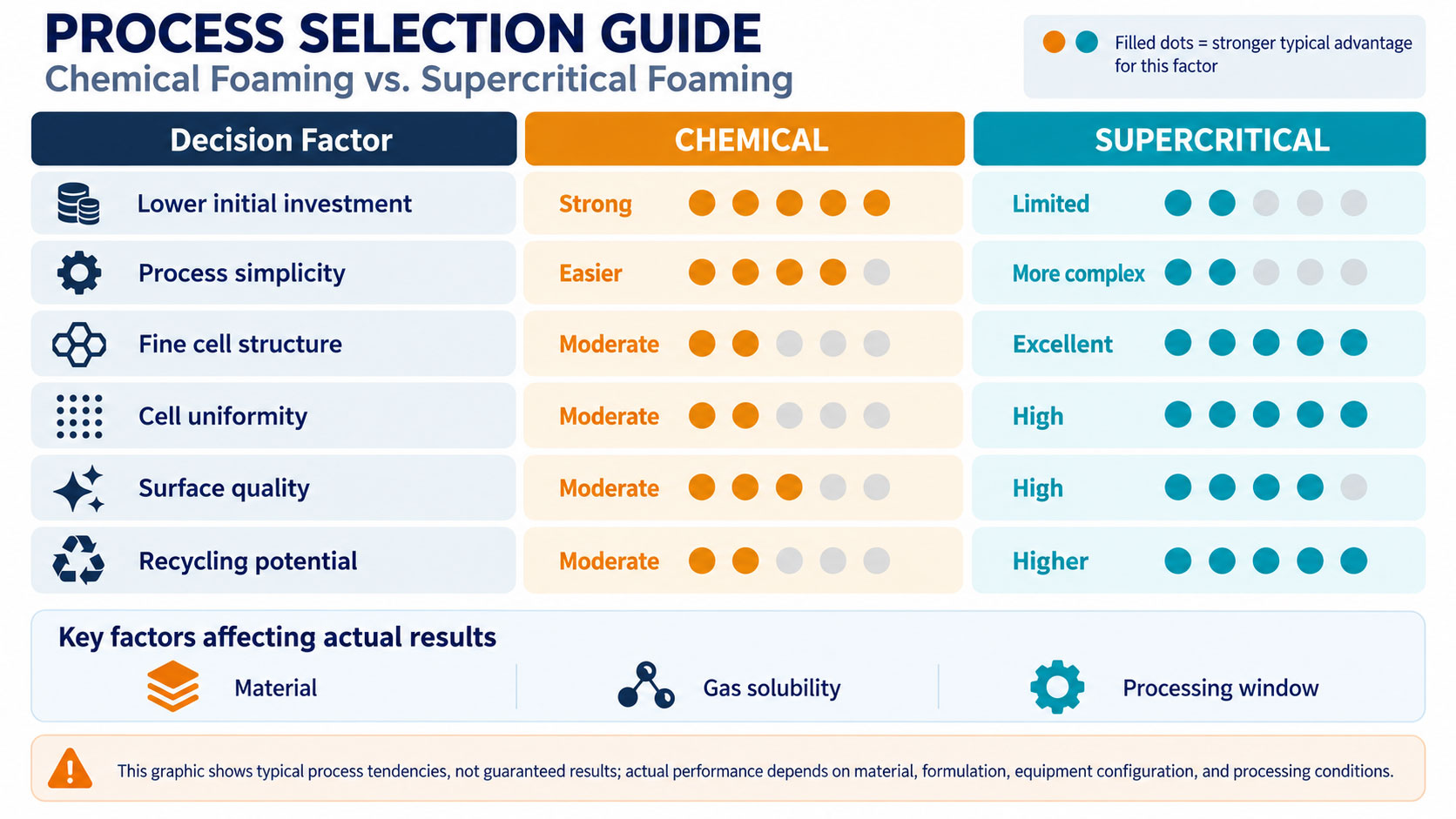
When Chemical Foaming Is the Preferred Option
Established internal mixing, compression molding, extrusion, or injection equipment enables a lower-investment entry.
Products are thick or geometrically complex, and current formulations already provide stable cell control.
Order volume or product life cycle does not justify investment in high-pressure equipment.
Compliant chemical blowing agents are permitted, with odor and residues manageable through formulation and post-treatment.
When Supercritical Foaming Deserves Priority Evaluation
The product gains clear value from low odor, cleaner formulations, weight reduction, or high cell density.
High order volumes and long-term stable specifications allow equipment and development costs to be amortized.
The material has suitable gas solubility, melt strength, and dimensional stabilization.
The team can control pressure, gas concentration, temperature, pressure-drop rate, and mold thermal management.
10. Six Questions to Validate Before Introducing Supercritical Foaming
1 Can the material absorb enough gas? | First determine CO₂/N₂ solubility and diffusion behavior; do not judge by the resin name alone.
2 Is melt strength sufficient to stabilize cells? | Check cell coalescence, rupture, post-shrinkage, and cell-wall stability.
3 Does the product surface permit microcellular marks? | Injection-molded surfaces may be affected by gas escape, mold temperature, and the flow front.
4 Can weight reduction create commercial value? | Include raw-material savings, cycle time, yield, and equipment depreciation in one cost model.
5 Are specifications stable over a sufficient production life? | High-pressure systems are better suited to long-running, consistent, reproducible product platforms.
6 Does it truly improve environmental performance? | Evaluate energy use, material savings, scrap rates, and recycling pathways comprehensively.
Conclusion: Product Value Determines the Process—New Technology Does Not Simply Replace Old
Chemical foaming is mature and flexible, with comparatively low capital requirements. It fits diverse product portfolios and existing production platforms. Supercritical foaming offers potential for higher cell density, less blowing-agent residue, and lighter materials, but requires greater investment in equipment, control, and materials engineering.
Where the only goal is lower density, established chemical foaming often offers strong cost-effectiveness. When requirements also include low odor, fine cells, material savings, high performance, and a stable long-term production platform, supercritical foaming may offer differentiation that justifies the investment. The optimal route may even combine physical foaming, chemical foaming, crosslinking, or nucleation technologies according to the material and product.