From a Reference Foam Sample to Production Ready Material
FOUND FAIR Custom Foam Formulation Development Model
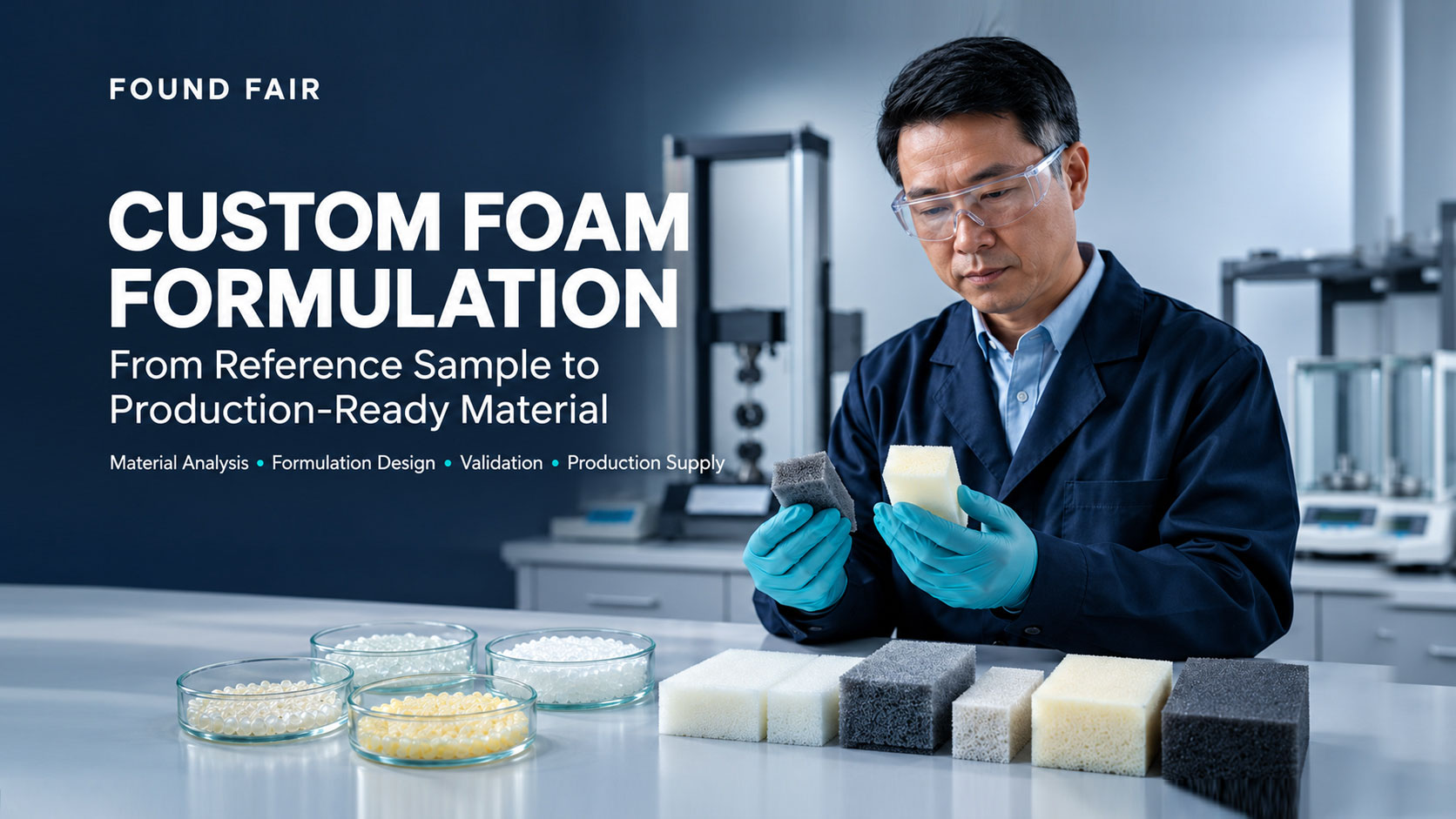
Customers provide a specification or physical reference sample. FOUND FAIR handles material diagnosis, formulation design, testing and validation, mold trials, and long-term material supply.
Executive Summary Turning Raw Material Sales into Material Problem Solving
In the development of footwear materials, insoles, sports protectors, and foamed products, the real challenge is often not finding EVA, POE, TPE, or other resins. It is balancing hardness, density, rebound, shrinkage, tear strength, compression set, appearance, and processing stability. Standard grades provide a starting point; final performance still depends on the material blend, crosslinking and foaming systems, mixing and dispersion, molds, and processing window.
Custom Foam Formulation is therefore a development service, not merely a formulation transaction. It covers requirement definition, material analysis, formulation hypotheses, experimental design, sample validation, and production control. FOUND FAIR can draw on its experience in polymer materials, foaming, injection molding, mold trials, and finished-product production to shorten the path from concept to production, while building recurring revenue through long-term custom material supply.
1 Why the Market Needs Custom Foam Formulations
1.1 The Same High Rebound Request Can Involve Different Material Problems
When engineers ask for high rebound, they may mean vertical rebound, energy return, rapid recovery, low compression set, or simply a more springy feel. Unless the test method, specimen thickness, temperature, humidity, and target values are defined first, an apparent formulation improvement may not be reproducible in the customer’s product.
1.2 Softness Light Weight Rebound and Dimensional Stability Are Interdependent
For example, adding a softer, lower-melting POE to an EVA system may improve softness and elastic feel. However, unless melt strength, crosslinking level, cell structure, and cooling and setting are adjusted together, the product may shrink or exhibit dimensional drift. Custom formulation creates value by addressing these competing performance goals, rather than simply increasing one ingredient.
1.3 Customers Need Production Results as Well as Laboratory Data
An impressive laboratory technical data sheet (TDS) does not guarantee stable performance on the customer’s mixers, injection molding machines, molds, or cooling conditions. A commercially valuable solution must deliver both material performance and a processing window, confirmed through three stages: small-sample evaluation, mold trials, and batch consistency validation.
2 The FOUND FAIR Service From a Problem to Production Ready Material
FOUND FAIR’s custom foam formulation service can be defined as developing dedicated foam materials with verifiable performance, reproducible processing, and controllable quality, based on the customer’s target specifications, reference samples, application conditions, and production equipment.
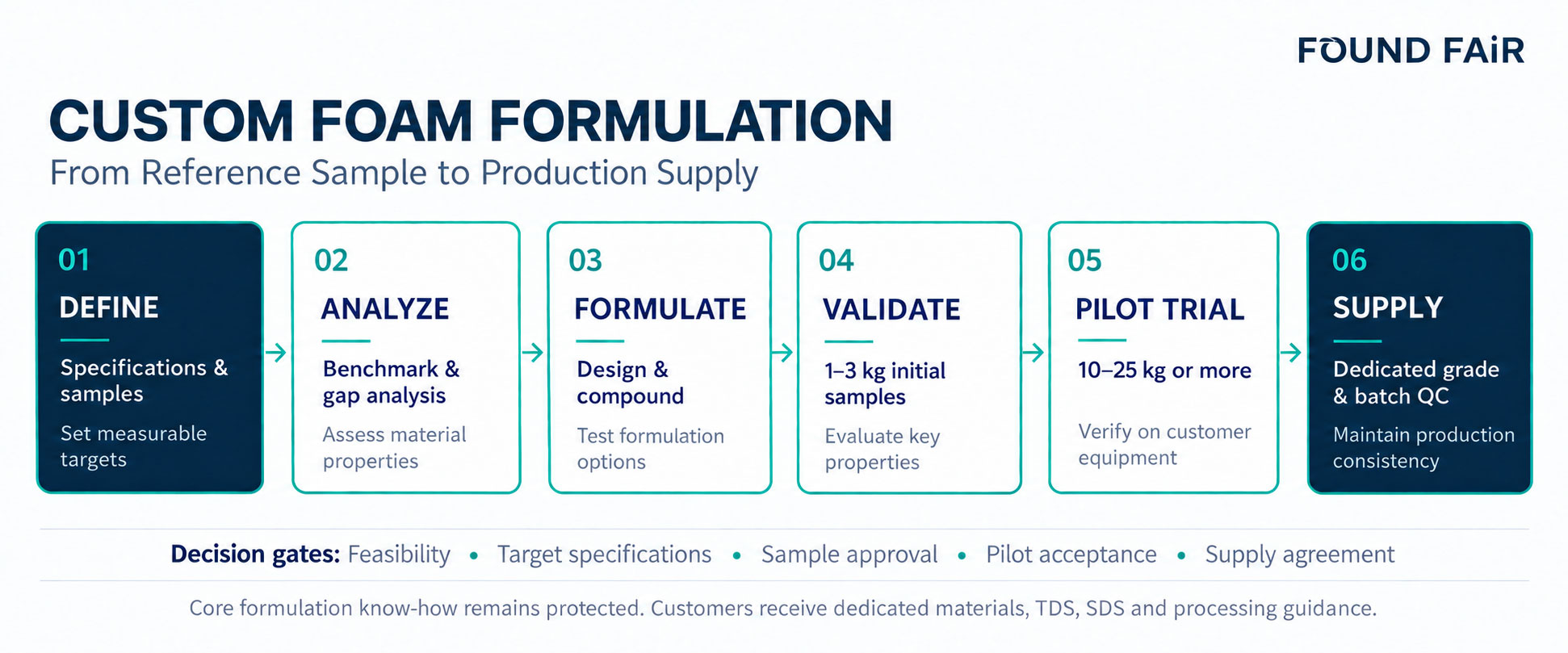
3 The Six Stage Development Process
Stage 1 — Define requirements: Confirm the final product, target market, material restrictions, estimated annual consumption, cost target, equipment, molds, and development schedule. Descriptions such as “more springy” or “softer” should be converted into measurable acceptance criteria.
Stage 2 — Analyze samples and performance gaps: Compare the reference sample with the target specifications. Establish benchmarks for hardness, density, rebound, dimensions, mechanical and thermal properties, and cell structure. Identify deviations caused by aging, post-processing, or test conditions.
Stage 3 — Design formulations and experiments: Build formulation hypotheses around compatibility, melting behavior, crosslinking reactions, expansion ratio, and processing method. Use small batches and experimental design to progressively narrow the development window and avoid repeated trials without a clear direction.
Stage 4 — Provide initial samples of 1–3 kg: Supply the first round of laboratory evaluation material for the customer to assess basic processability and key physical properties. Three kilograms is suitable for preliminary testing, but full injection molding, foaming, or mold setup generally requires reassessing the quantity needed.
Stage 5 — Conduct mold trials using 10–25 kg or more: Verify filling, foaming, demolding, cooling, shrinkage, appearance, and yield on the customer’s actual equipment and molds. Fine-tune the material or process based on the trial results.
Stage 6 — Finalize the grade and supply production material: Establish a dedicated customer material code, TDS, safety data sheet (SDS), inspection specifications, retained samples, and change management. Batch consistency and supply reliability turn a one-time development project into a long-term material business.
4 Information Customers Should Provide
| Input | Recommended information | Why it matters |
|---|---|---|
| Target specifications | Hardness, density, rebound, tear strength, compression set, shrinkage, etc. | Convert subjective needs into acceptance criteria |
| Reference samples | Resin pellets, foam specimens, semi-finished products, or finished products | Establish a baseline and identify gaps |
| Application and regulations | Insoles, midsoles, protectors, or pet products; countries of sale | Determine safety, durability, and compliance requirements |
| Equipment and molds | Mixing, injection molding, compression molding, or supercritical foaming equipment; cavity details | Ensure compatibility with the actual process |
| Processing conditions | Temperature, time, pressure, cooling, and conditioning | Identify interactions between material and process |
| Commercial conditions | Cost target, monthly/annual consumption, schedule, and minimum order quantity (MOQ) | Assess the project’s production and commercial potential |
5 Technical Validation Turning Subjective Impressions into Production Specifications
Select tests according to the intended use and mutual agreement. The following is a common evaluation framework for foam materials. A property may be measured by several methods; values should not be compared directly until specimens, environments, and methods have been standardized.
| Property | Common assessment or method | Development insight |
|---|---|---|
| Hardness | Shore C, Asker C, or an agreed method | Softness, support, and feel |
| Density / expansion ratio | Mass and volume; foam expansion ratio | Weight, cost, and cell loading |
| Rebound / energy return | ISO 8307, ASTM D2632, or dynamic testing | Recovery speed and dynamic performance |
| Tensile strength and elongation | ASTM D412 or a specified method | Toughness and tolerance during forming |
| Tear strength | ASTM D624 or a specified method | Resistance to notch propagation and damage |
| Compression set | ASTM D395, ISO 1856, or a specified method | Thickness retention after extended use |
| Dimensional stability | Room-temperature conditioning, heat shrinkage, and post-molding dimensional tracking | Shrinkage, warpage, and tolerances |
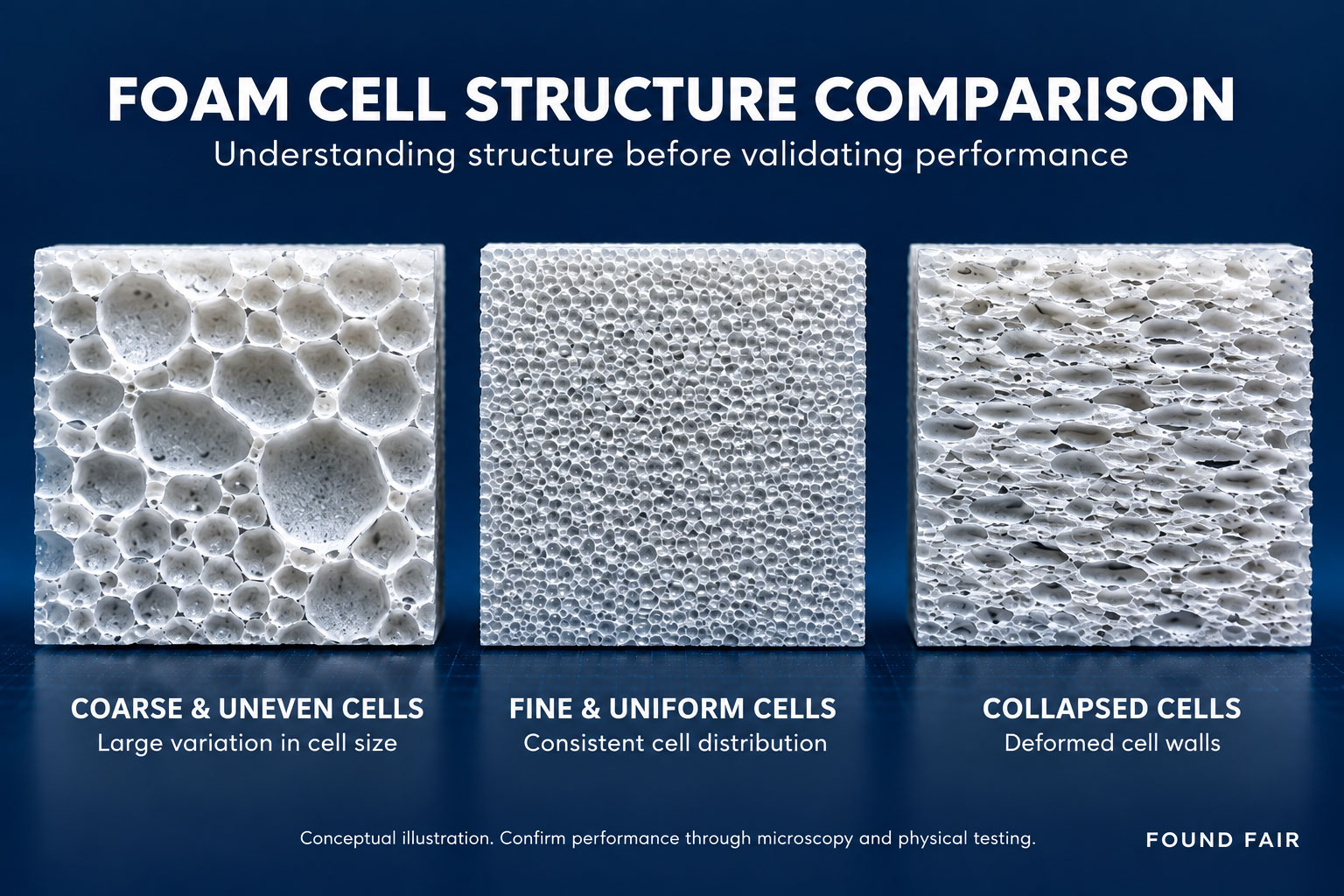
| Cells and appearance | Cross sections, microscopy, skin, and defects | Nucleation, coalescence, cell collapse, and dispersion |
| Biobased content | ASTM D6866 carbon-14 testing | Verify the renewable carbon fraction; this does not establish biodegradability |
6 The Business Model Free Initial Review Staged Fees and Long Term Supply
If all custom development is free, it can attract sample requests without a production plan. High upfront development fees, however, can discourage new customers from testing. A suitable approach for FOUND FAIR is to offer a free feasibility review, then charge in stages according to the technical effort and commercial value.
| Stage | Deliverables | Suggested charging approach | Primary purpose |
|---|---|---|---|
| A Initial review | Requirement interview, information completeness, and feasibility assessment | Generally free | Qualify business projects |
| B First samples | Initial formulation and up to 1–3 kg of evaluation material | May be free for qualified projects; freight depends on location and eligibility | Obtain real processing feedback |
| C Development | Analysis, formulation design, iterative adjustments, and reports | Development fee based on difficulty; part may be credited against production orders | Recover R&D investment |
| D Mold trials | 10–25 kg or more of material; on-site or remote technical support | Charge for material and freight; technical service fees by agreement | Confirm the production window |
| E Supply | Dedicated grade, batch QC, and change management | Material margin plus minimum purchase volume | Build recurring revenue |
| F Tech buyout | Complete formulation, raw material list, and process transfer | Substantial technology transfer fee | An exception rather than the core model |
7 Formulation Intellectual Property Dedicated Supply and Technology Ownership
FOUND FAIR’s core model should be custom material supply rather than delivery of the complete formulation. Customers receive a dedicated grade, TDS, SDS, recommended processing window, and quality assurance. FOUND FAIR retains core know-how, including resin combinations, additives, and the proportions in the crosslinking and foaming systems.
Customers retain ownership of their original samples, drawings, specifications, and confidential information.
FOUND FAIR retains ownership of its existing material platforms, experimental methods, and process know-how.
Contracts should clearly define usage rights for project-derived formulations, exclusivity scope, duration, territories, and minimum purchase volumes.
If a customer requests a complete formulation and process buyout, separately assess the loss of future supply margins, technology value, and non-compete restrictions.
8 FOUND FAIR Competitive Advantages
| Conventional raw material supply / trading | FOUND FAIR custom foam formulation model |
|---|---|
| Offers existing grades and standard TDS documents | Designs materials starting from the customer’s problem |
| Addresses materials separately from molds and equipment | Considers materials, foaming, injection molding, molds, and cooling together |
| Competes mainly on unit price and lead time | Creates value by resolving shrinkage, rebound, mold sticking, strength, and production stability |
| Sends samples and waits for customer testing | Establishes test feedback forms, gap analysis, and decisions for the next round |
| Primarily one-time transactions | Combines development fees, mold trial services, and long-term dedicated material supply |
For FOUND FAIR, the key distinction is the ability to close the loop from formulation to finished-product production, rather than claiming access to more raw materials. This means understanding why materials fail and why a formulation that succeeds in the laboratory may still fail in the customer’s mold.
9 Suitable Application Areas
Insoles and Midsoles
Focus on light weight, high rebound, support, compression durability, dimensional stability, and bonding. Select systems such as EVA, POE, TPE, SEBS, TPEE, or PEBA according to cost and performance requirements.
Sports and Motorcycle Protectors
Focus on impact absorption, thickness efficiency, low-temperature flexibility, body conformity, and recovery after repeated impacts. Formulations must be developed together with structural design and test standards.
Pet Toys and Specialty Foamed Products
Focus on softness and rebound, tear strength, surface friction, odor, coloring, regulations, and safe use. Bite resistance cannot be determined from a single tensile or tear result; product structure and actual use conditions must also be considered.
Biobased and Low Carbon Materials
Prioritize verifiable biobased content, retained performance, and production stability. Biobased content, carbon footprint, and biodegradability are separate topics and must not be used interchangeably in external communications.
10 Turning Technical Content into Sales Inquiries
FOUND FAIR can turn common R&D problems into English and Vietnamese technical articles. When customers search Google or AI tools for “Why does EVA foam shrink?”, “How can rebound be improved without dimensional instability?”, or “Can foam materials be developed from a sample?”, they first discover solutions and then learn about FOUND FAIR.
Attract traffic: Publish comparison articles on EVA, POE, TPE, supercritical foaming, and biobased materials.
Build trust: Share test methods, problem diagnosis, anonymized cases, and production considerations.
Encourage action: Invite customers to submit specifications and processing conditions or send reference samples.
Convert inquiries into business: Complete initial reviews, 1–3 kg sample evaluations, mold trials, quotations, and dedicated material supply.
11 Suggested External Copy
Suggested action buttons
Submit Your Specification
Request a Material Feasibility Review
Send a Reference Sample
12 Conclusion Reducing Development Failures Is the Value FOUND FAIR Delivers
The commercial value of Custom Foam Formulation lies in converting vague needs into measurable specifications, reference samples into production-ready materials, and one-time trials into stable supply relationships, rather than selling a formulation sheet. This approach requires stronger R&D discipline, testing capability, process understanding, and intellectual property management than conventional raw material sales. It can also build stronger customer loyalty and competitive advantages that are harder to replace through price alone.
Technical Notes
The test methods listed are common references. Actual tests, specimens, conditions, and acceptance criteria should be confirmed for the material, product, equipment, customer specifications, and applicable regulations. The cell structures shown are conceptual illustrations, not measured test reports for any specific grade. Reference sample analysis and material development should proceed only after confirming lawful sample sourcing, confidentiality obligations, and intellectual property boundaries.
Document purpose: FOUND FAIR custom foam materials technical article and business model proposal | Version: September 2026