

IUS-4065 and Low Melting Point POE
Balancing low hardness, resilience and dimensional stability during secondary processing
IUS-4065 for EVA / POE foam formulation. Product forms are illustrative.
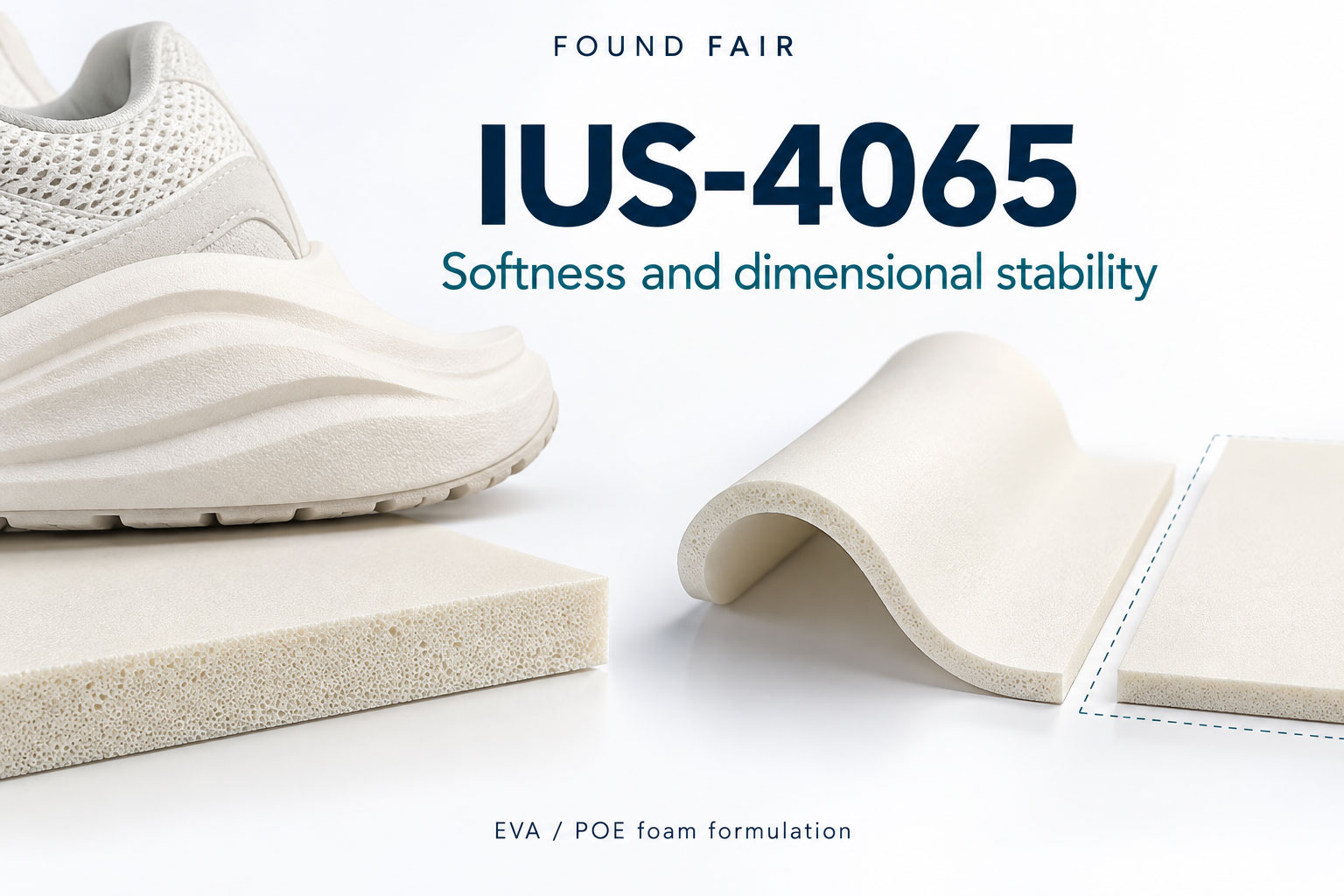
The development challenge. Conventional formulations use soft POE to reduce EVA hardness and improve resilience. If the POE melting range is too low, subsequent lamination, oven heating or other thermal processing may weaken crystalline support and increase shrinkage, warpage and dimensional drift. IUS-4065 is positioned to balance very low hardness with a higher melting point.
1 Selecting soft POE requires more than low hardness
In chemically crosslinked EVA foam formulations, POE is often used to adjust softness, elastic feel and low-temperature toughness. Developers may select a softer POE to reach the target hardness at a lower loading. However, raw resin hardness is only the first requirement. If the material loses sufficient crystalline support at downstream processing temperatures, a part that looks dimensionally correct after demolding may undergo secondary shrinkage during lamination, hot pressing, oven heating or prolonged hot storage.
Key assessment. Low hardness does not necessarily mean a low melting point. However, many very soft polyolefin elastomers also have lower crystallinity and a lower melting range. Evaluate hardness, DSC melting behavior, crosslink density and the final secondary processing temperature together.
2 Why low melting point POE can increase secondary shrinkage
A foamed part is not a completely static structure. Cell pressure, molecular orientation, the crosslinked network, crystalline regions and residual cooling stresses coexist within the material. When secondary processing approaches or exceeds the main melting range of the POE, the crystalline regions that provide physical support progressively weaken. Molecular chains can relax, and cell walls can rearrange more readily.
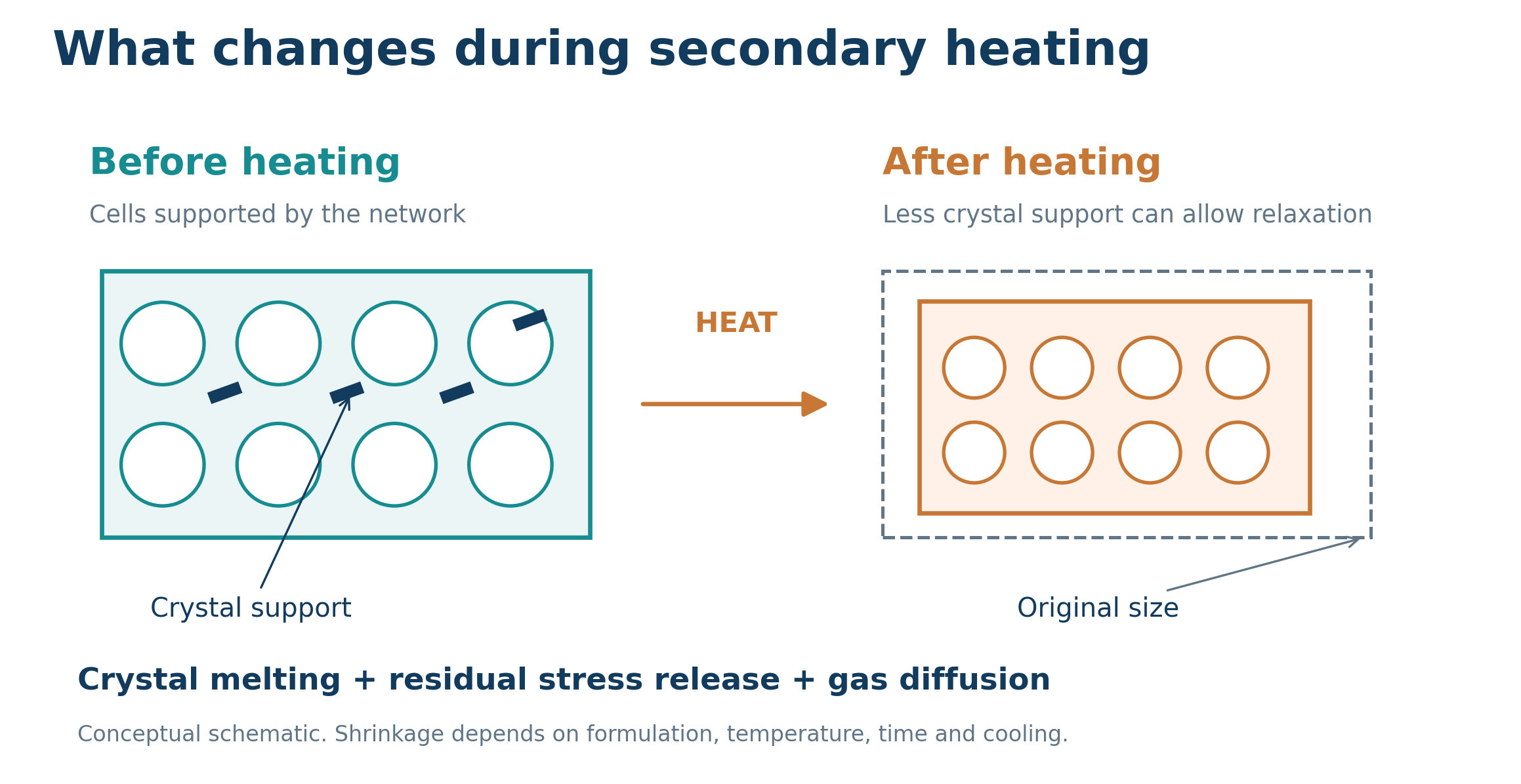
Reduced crystalline support. Secondary heating melts some crystalline regions, reducing the resistance of cell walls to deformation.
Release of residual stress. Orientation generated during foam expansion, mold opening and cooling begins to recover.
Diffusion of cell gases. Longer exposure and higher temperature increase diffusion rates and may change pressure differences across cell walls.
Insufficient or uneven crosslinking. Thermal shrinkage becomes more pronounced if the DCP network cannot effectively hold the dimensions.
Incomplete cooling and stabilization. Core temperature, thickness variation and stacking practices can all contribute to later dimensional drift.
3 The design value of IUS-4065
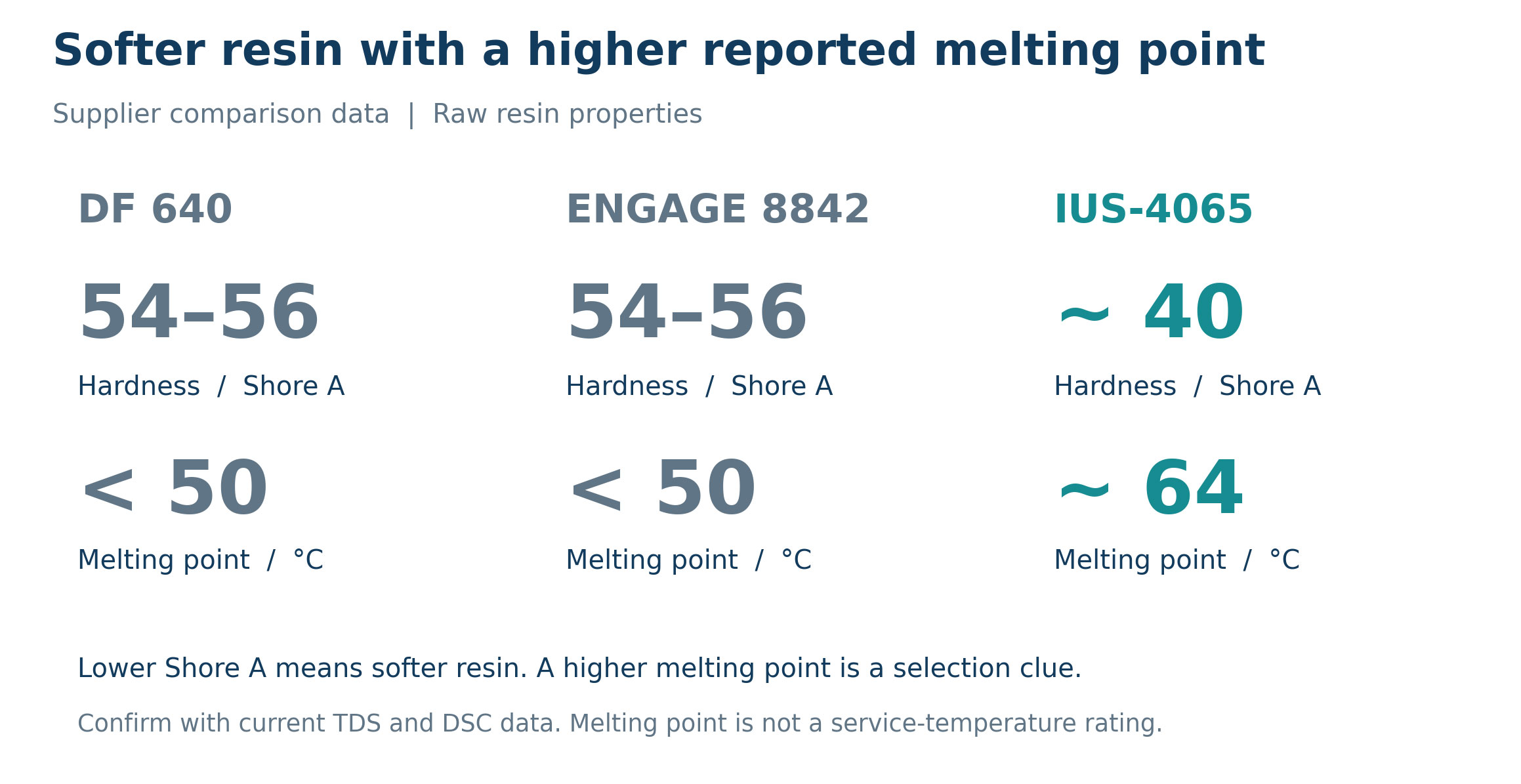
Softness does not have to depend on an excessively low melting point. According to the supplier comparison data, DF 640 and ENGAGE 8842 have a hardness of approximately Shore A 54–56 and a melting point below 50°C. IUS-4065 has a hardness of approximately Shore A 40 and a melting point of about 64°C. Its proposition therefore extends beyond softness: it aims to retain a higher range of thermal support at a lower hardness.
| Property | DF 640 / ENGAGE 8842 | IUS-4065 | Development relevance |
|---|---|---|---|
| Raw resin hardness | Shore A 54–56 | Shore A ~40 | Potential for a softer feel at the same loading, or a lower loading to reach the target. |
| Melting point | Below 50°C | About 64°C | Potentially greater physical support during secondary processing above 50°C. |
| Thermal shrinkage risk | Higher in supplier comparison | Lower in supplier comparison | Potential to improve dimensional control during lamination, hot pressing and finishing. |
| Dimensional stability | Lower in supplier comparison | Higher in supplier comparison | May reduce warpage, appearance variation and rework. |
| Processing stability | More sensitive to formulation and temperature | Better according to supplier | Requires confirmation of the DCP foaming window and production performance. |
4 How a higher melting point can help dimensional stability
At the same secondary processing temperature, a soft modifier that retains more unmelted crystalline regions can provide temporary physical crosslink points. These regions help cell walls resist thermal relaxation and deformation. Compared with reference materials melting below 50°C, the reported melting point of about 64°C for IUS-4065 may increase the separation between some lamination or finishing temperatures and the principal melting range.
However, melting point alone is not a heat-resistance rating. DSC may show broad or multiple melting peaks. Actual dimensional stability also depends on POE loading, the vinyl acetate (VA) content of EVA, DCP crosslink density, expansion ratio, cell wall thickness, cooling conditions and exposure time. The value of 64°C is a material selection advantage and a starting point for validation, rather than a guarantee that every finished part can safely withstand 64°C.
5 Potential benefits in EVA and POE foam formulations
More efficient hardness reduction
Lower raw resin hardness may allow a practical loading to achieve the desired softness. This may reduce crosslink dilution and property losses associated with adding large amounts of soft POE or processing oil solely to reduce hardness. Compare the actual hardness reduction at the same foam density.
Resilience and a flexible feel
The value of POE in EVA usually includes flexibility, low-temperature performance and energy recovery as well as hardness reduction. If IUS-4065 maintains a suitable molecular network at low hardness, it may be useful for insoles, midsoles, protective equipment and cushioning materials requiring comfort and resilience.
5 Potential benefits continued
Less dimensional drift after lamination
For foams requiring fabric lamination, hot pressing, oven heating or other secondary processing, a higher melting point may improve process tolerance and reduce secondary shrinkage, warpage, edge curling and appearance variation.
Higher yield and batch consistency
If current defects mainly arise from sensitivity to thermal history and dimensional recovery, a better material processing window may lead to higher yield and less reshaping or rework. Verify the benefit through A/B trials using the same mold, expansion ratio and secondary processing conditions.
6 Recalibrate the DCP formulation when changing POE
Replacing the existing POE with an equal weight of IUS-4065 while keeping DCP, blowing agent and molding conditions unchanged may not produce the best result. Different polymer structures can respond differently to peroxide radicals and have different melt viscosities and crystallization rates. These differences may alter the balance between crosslinking and gas generation.
| Parameter to recalibrate | Potential effect | Recommended approach |
|---|---|---|
| Effective DCP loading | Too little crosslinking can cause shrinkage; too much can restrict expansion and elongation. | Screen three dosage levels using rheology or cure curves. |
| Blowing agent and activation system | Gas generation may not match network formation in the new material. | Hold the target density constant; inspect cells and expansion after mold opening. |
| Actual compound temperature | Earlier softening of low melting point materials changes dispersion and scorch risk. | Record the actual material temperature, not only machine settings. |
| Molding and mold opening time | Controls cure completion, expansion ratio and residual stress. | Establish the window using core temperature and dimensional stability. |
| Cooling and conditioning | Affects crystallization, stabilization and subsequent shrinkage. | Standardize cooling, stacking and measurements at 24 and 72 hours. |
7 Validate more than hardness immediately after demolding
To demonstrate the value of IUS-4065, trials must simulate the customer’s actual secondary processing and service conditions. Include at least three groups: the existing formulation as a control, replacement at the same proportion, and an optimized formulation at the target hardness. Control finished foam density.
| Stage | Tests | Assessment focus |
|---|---|---|
| Raw resin | Shore A hardness, DSC melting peaks and enthalpy, MFR and density | Confirm differences in softness, melting range and flow. |
| 24 hours after foaming | Density, hardness, dimensions, cell structure and resilience | Exclude apparent advantages caused by a different expansion ratio. |
| 72 hours of conditioning | Length, width and thickness; hardness drift | Assess natural shrinkage and crystalline reorganization. |
| Lamination simulation | 50, 60 and 70°C at different exposure times | Establish the temperature–time–shrinkage relationship. |
| Mechanical properties | Tensile strength, elongation, tear strength and compression set | Confirm that hardness reduction does not compromise durability. |
| Production validation | Cavity position, batch variation, yield and rework rate | Translate material differences into manufacturing benefits. |
Core measurement
Dimensional shrinkage (%) = (dimension before heating − dimension after heating) / dimension before heating × 100%.
Measure length, width and thickness separately. Specify the conditioning period and measurement temperature clearly.
8 Products to prioritize
EVA / POE foam insoles and midsoles requiring low hardness and high resilience.
Foam sheets requiring subsequent fabric lamination, hot pressing or oven treatment.
Molded components sensitive to dimensional tolerances, surface flatness and warpage.
Sports protective equipment, cushioning pads and products requiring a soft, conformable feel.
Products using DF 640, ENGAGE 8842 or other soft, low melting point POE that already exhibit secondary shrinkage.
Conclusion
A useful very soft modifier must soften the product while preserving process stability. The conventional reason for adding POE to EVA is to lower hardness and improve resilience. However, if the melting range is too low, foam may lose crystalline support during lamination or secondary heating. Residual stress release, cell contraction and dimensional deformation can then become more pronounced. This is one reason a formulation can look satisfactory after demolding yet remain unstable during downstream processing.
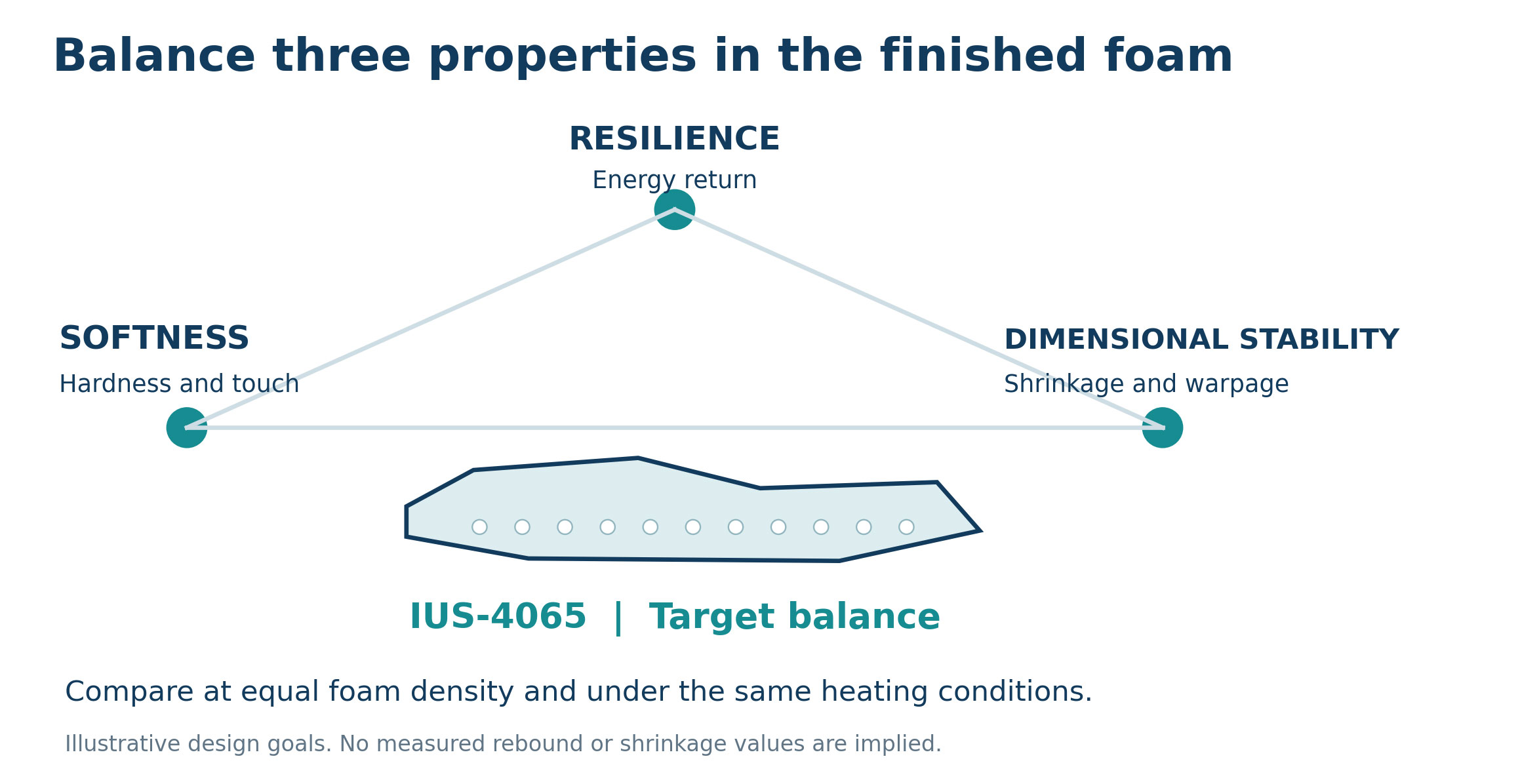
IUS-4065 is positioned to combine very low hardness of approximately Shore A 40 with a higher melting point of about 64°C, bringing softness, resilience and dimensional stability onto the same material platform. For developers, the most valuable question is whether it can reduce secondary shrinkage, widen the processing window and improve production yield at the same density and under the same performance requirements.
Development decision. Ask which material can maintain cell structure and dimensions under the customer’s lamination temperatures and service conditions, rather than assessing softness alone.
Data and technical statement. Hardness, melting point and qualitative comparisons for IUS-4065, DF 640 and ENGAGE 8842 are taken from the INNOARK image data provided by the user. Before external publication, verify these values against the supplier’s latest TDS, DSC reports and measurements from the intended formulation.