

Is Softer POE Always Better?
Five EVA Foaming Risks of Low-Melting POE: From Crystalline Domains and Crosslink Density to Cooling
Ultra-soft, low-melting POE can improve EVA foam softness and resilience, but may increase shrinkage, crosslink dilution, cell coalescence and dimensional instability. Learn the five key formulation risks.
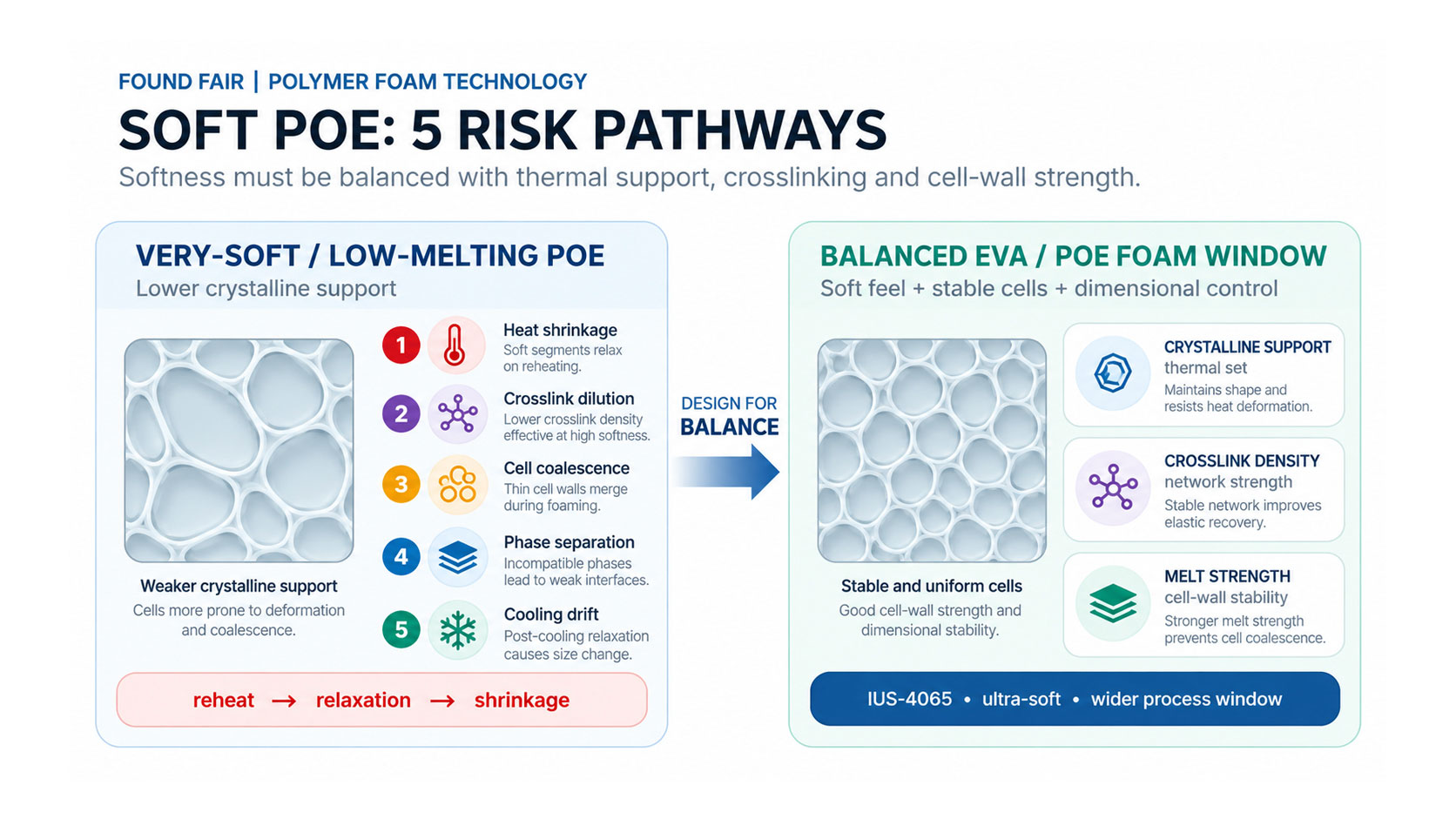
1. Why Do R&D Engineers Add POE to EVA?
EVA is an ethylene-vinyl acetate copolymer. As VA content increases, the regular crystallization of polyethylene-rich segments is disrupted, making the material softer while increasing polarity and adhesion. POE is typically a metallocene-catalyzed ethylene/α-olefin copolymer with a relatively narrow molecular-weight distribution and controllable short-chain branching, and it can function as a flexible phase with a low glass-transition temperature. Because EVA and POE share ethylene-rich chain segments, they have a useful compatibility foundation; POE is therefore often used to lower EVA-foam hardness, improve low-temperature toughness, and enhance energy recovery.
| Benefit from POE | Polymer-Level Reason | Possible Trade-Off |
|---|---|---|
| Lower hardness | Low modulus, low Tg, and lower crystallinity | Crystalline support and thermal setting may decrease |
| Improve flexibility & rebound | More elastic chain segments and lower brittleness | Crosslinking and cell-wall strength must be rebalanced |
| Improve low-temperature performance | Chain segments retain mobility at low temperature | Relaxation can also occur more readily at elevated temperature |
| Tune touch and expansion ratio | Changes melt viscoelasticity and foaming behavior | Phase size and the gas-generation window become more sensitive |
2. Hardness Is an Outcome, Not a Complete Material Specification
Shore A hardness is influenced by test temperature, specimen thickness, indenter dwell time, crystallinity, and oil content. Two POEs both rated Shore A 40 can still have different DSC melting peaks, enthalpy of fusion, molecular weight, long-chain branching, melt strength, and peroxide reactivity. Therefore, hardness alone cannot predict cell structure or dimensional stability after DCP foaming.
3. Risk 1: A Low Melting Range Can Magnify Secondary Heat Shrinkage
Crystallizable ethylene sequences in POE can act as temporary physical crosslinks. When lamination, hot pressing, or oven temperature approaches the melting range, crystalline domains progressively melt and the instantaneous modulus of the cell wall drops. Molecular orientation and residual stress left by foaming and cooling can then relax. If the covalent crosslink network is insufficient, length/width shrinkage, thickness pullback, and warpage become more pronounced.
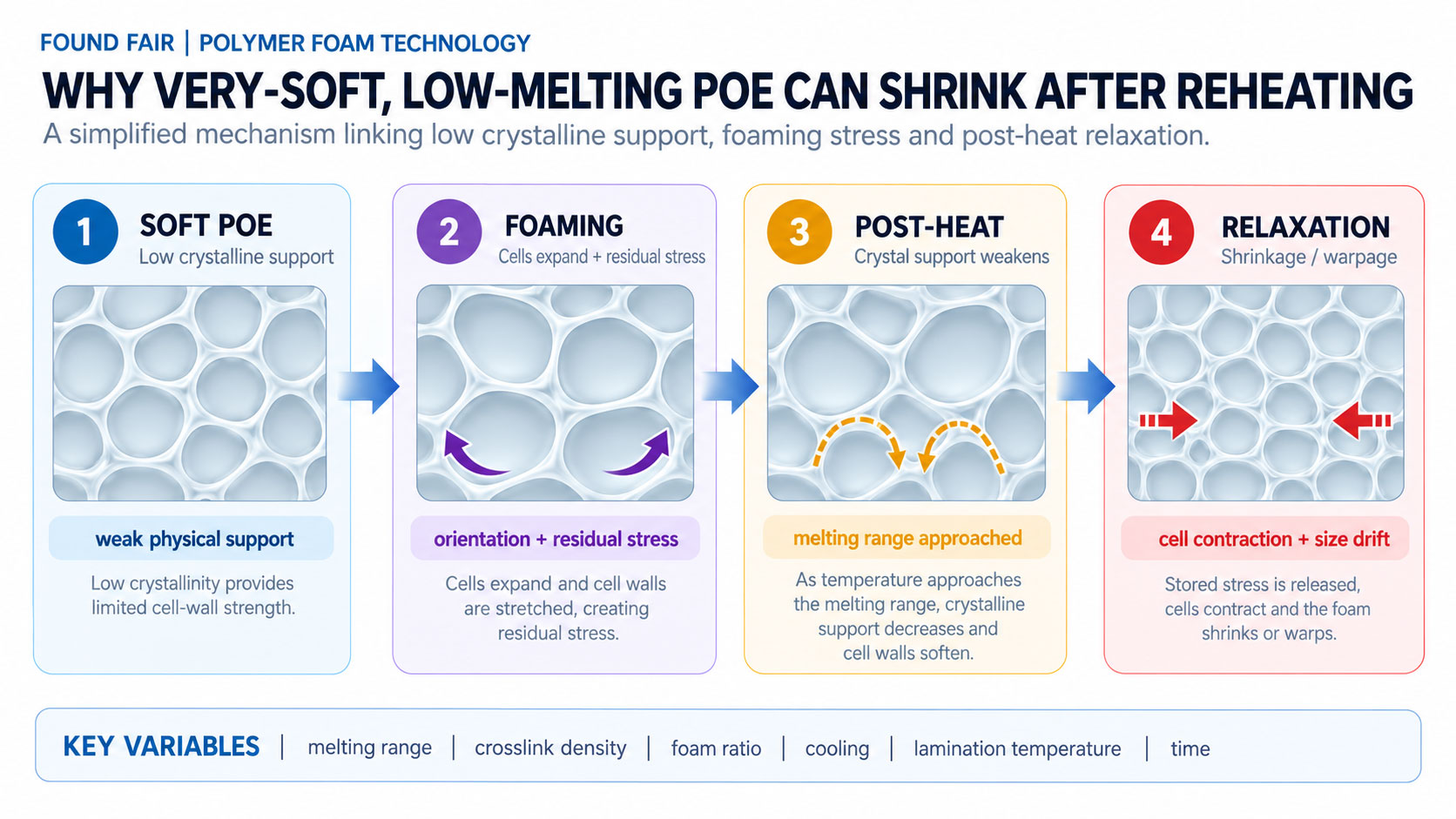
Important: melting point is not a single on/off switch. DSC can show broad or multiple melting peaks. Review onset, peak, enthalpy of fusion, and peak width together, and compare them with actual lamination temperature and heating time.
4. Risk 2: As the POE Fraction Rises, Effective DCP Crosslink Density May Be Diluted
When DCP is heated, it generates free radicals that abstract hydrogen from polymer chains and form macroradicals; radical coupling can then create C–C crosslinks. EVA and different POE grades vary in hydrogen-abstraction sites, branch structure, molecular weight, and antioxidant systems, so equal-weight replacement does not guarantee equal crosslink efficiency. As a less-reactive soft phase increases, the effective network-chain density per unit polymer may decrease.
MDR/ODR t10, t90, and maximum torque difference can be used to observe the reaction window, while gel fraction or equilibrium swelling can be used to estimate network integrity. Under-crosslinking may allow cell retraction after demolding; over-crosslinking may restrict expansion and reduce elongation and tear resistance.
5. Risk 3: Insufficient Melt Strength Leads to Cell Growth, Coalescence, and Collapse
During foaming, gas expansion stretches the cell walls, while the viscoelastic melt must provide enough extensional viscosity and strain hardening to resist rupture. Very soft POE may reduce the storage modulus and melt elasticity of the blend. If gas generation occurs before the crosslink network is sufficiently developed, drainage through the cell film accelerates, broadening the cell-size distribution and promoting coalescence, collapse, or skin sink marks.
MFR reflects only apparent flow behavior under a specified temperature and load; it does not fully describe low-frequency storage modulus, melt strength, or extensional rheology. Two POEs with similar MFR can still show completely different cell stability because of differences in molecular-weight distribution and long-chain branching.
6. Risk 4: Viscosity-Ratio and Interfacial-Tension Mismatch Creates Coarse Dispersed Domains
EVA/POE is not molecularly miscible under every VA content, molecular weight, and temperature. Droplet breakup can be understood through the capillary number Ca = ηm·γ̇·R/σ: higher matrix viscosity ηm, shear rate γ̇, or droplet radius R increases the breakup driving force, while higher interfacial tension σ favors droplet retention. If POE melts too early and its viscosity becomes too low, it may disperse readily at first yet recoalesce in low-shear zones.
Coarse domains can become initiation sites for tear cracks and can also make local DCP and blowing-agent distribution nonuniform. R&D should examine phase size by SEM/AFM, selective etching, stained microtomy, or at least optical sectioning rather than judging only whether the compound surface appears smooth.
7. Risk 5: Cooling Crystallization and Cell Setting Fall Out of Sync
After demolding, dimensions are governed by three competing time scales: gas diffusion, crosslink-network recovery, and crystal regeneration. Low-crystallinity, low-melting POE has limited crystallization rate and crystal perfection. Thick sections cool more slowly at the core than at the surface, so a part may pass dimensional inspection immediately after demolding yet drift after 24 or 72 hours. Stacking pressure, air-cooling direction, fixtures, and ambient temperature can all influence the result.
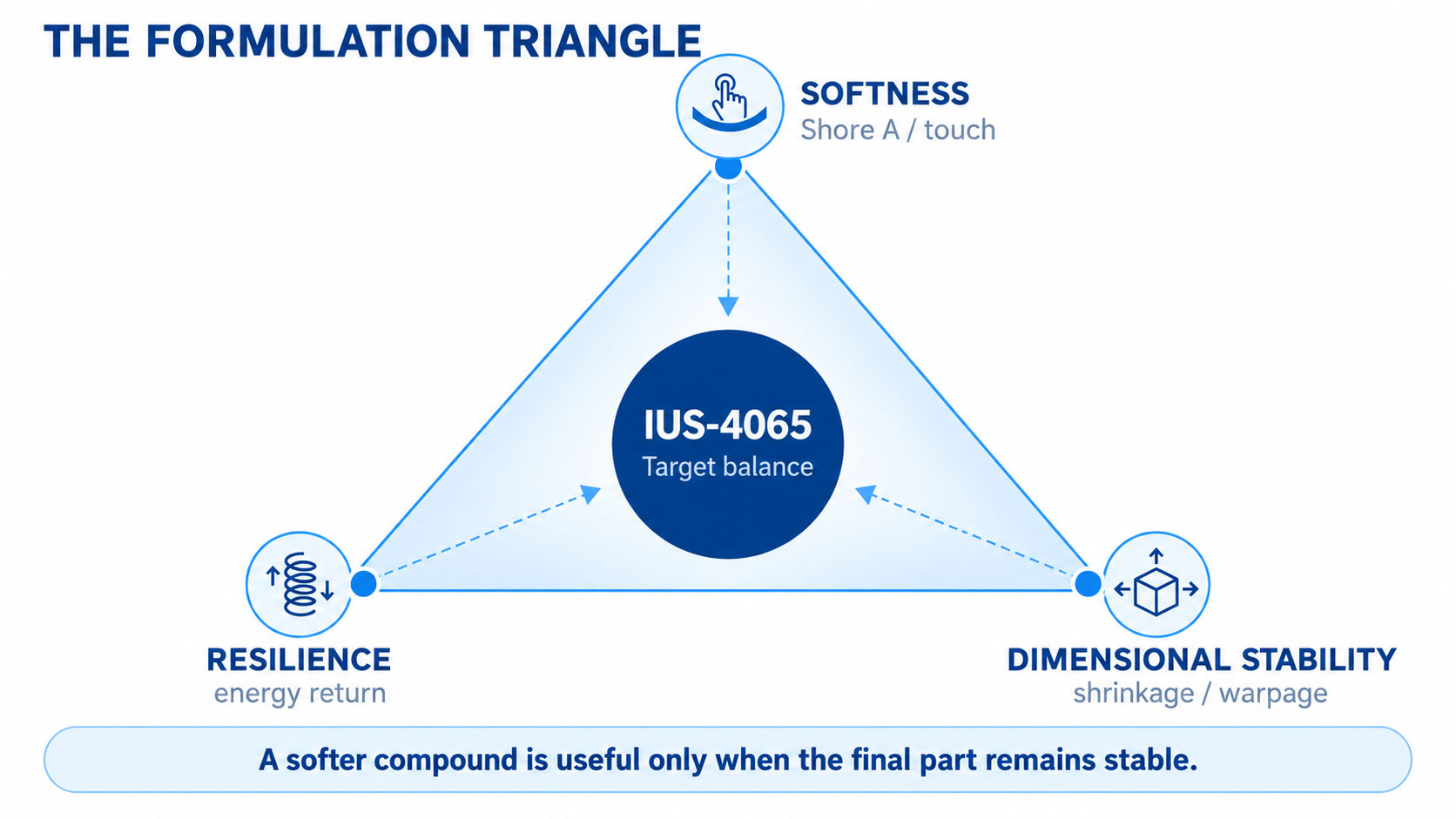
8. How Do the Five Risks Amplify One Another?
| Starting Change | Intermediate Mechanism | Final Failure Mode |
|---|---|---|
| POE crystallinity / Tm decreases | Less physical support from crystalline domains | Post-lamination shrinkage and warpage |
| POE fraction increases | Effective DCP network-chain density decreases | Post-demold retraction and higher compression set |
| Melt elasticity decreases | Cell-film drainage and cell coalescence | Broader cell-size distribution and lower tear strength |
| Viscosity ratio is mismatched | Dispersed-phase recoalescence and weak interfaces | Hard spots, crack initiation, and lot-to-lot variation |
| Cooling is too slow or uneven | Crystal reorganization and stress relaxation become unsynchronized | 24/72 h dimensional drift |
9. Recommended R&D Verification Method
| Stage | Test Item | Interpretation Focus |
|---|---|---|
| Raw material | Shore A, density, MFR, DSC second heating | Confirm Tm, ΔHm, peak width, and flow differences |
| Compound | MDR/ODR, gel fraction, swelling, DMA | Effective crosslinking, phase transition, and plateau modulus |
| Foam | Density, hardness, rebound, tear, cell images | Compare all properties at similar density |
| Thermal history | 50/60/70°C × time; 24/72 h dimensions | Build shrinkage curves in length, width, and thickness |
| Mass production | Cavity position, batch, discharge temperature, yield | Confirm laboratory differences translate into process benefit |
10. Recommended Sequence for Formulation and Process Improvement
First reduce the fraction of low-melting POE, or introduce an ultra-soft material with a higher melting range, to confirm whether insufficient thermal support is the root cause.
Recalibrate the effective DCP dosage using MDR plus gel/swelling data; do not infer crosslinking from hardness alone.
Adjust the blowing agent and activator so network formation begins slightly before the rapid gas-generation region.
For high-viscosity or multiphase formulations, use twin-screw precompounding to improve phase size; add DCP and blowing agent later in the process at lower temperature when appropriate.
Standardize cooling, post-aging, stacking, and lamination conditions before comparing 24/72 h dimensions.
Conclusion: Use the “Finished-Part Window,” Not Raw-Material Hardness, as the Selection Criterion
Low-hardness POE remains highly valuable for EVA foaming. The issue is not softness itself; the issue is whether R&D simultaneously controls the melting range, network formation, phase morphology, cell-wall strength, and downstream thermal history. A meaningful comparison should be made at the same finished-part density, expansion ratio, and post-treatment conditions, then evaluated for hardness, rebound, tear strength, compression set, and 72-hour dimensions.